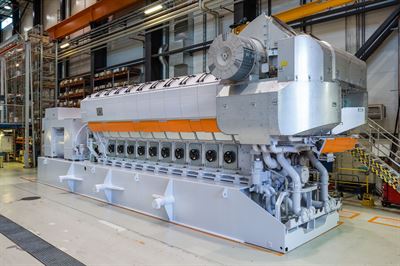
Wärtsilä has booked an order in Q1 2026 to supply generating sets for a new 123 MW merchant power plant in Odessa, Texas — the largest Wärtsilä 31 installation worldwide — and will operate and maintain the plant under a 10-year O&M contract. The plant will use ten Wärtsilä 31SG engines, deliver equipment in early 2027 and target commercial operation about one year later, supplying ERCOT and serving roughly 30,750 homes; the order was placed by Saulsbury Industries on behalf of IPP EMPower USA. The transaction enhances Wärtsilä’s recurring-service backlog and U.S. IPP footprint, underlining the company’s role in flexible, low-CO2 power capacity that supports project bankability in merchant markets.
Market structure: Wärtsilä (HEL:WRT1V) and EPC/O&M providers are clear winners — equipment sale + 10‑year O&M converts a one‑off booking into a multi‑year annuity and raises barriers for pure equipment suppliers. Competing losers are short‑duration battery pure‑plays and legacy inflexible thermal peakers that compete for ERCOT capacity revenues; the 123 MW plant is ~0.16% of ERCOT summer peak (~75 GW) so system price effects are negligible but capacity/availability economics at peak hours matter. Cross‑assets: modest upward pressure on localized Texas gas burn (negligible on Henry Hub unless replicated at scale), positive for industrial service equities (GE, CMI), neutral for USD and rates; limited bond spread tightening for Wärtsilä but project finance credit for EMPower remains idiosyncratic.
Risk assessment: Tail risks include an EPA/regulatory tightening on methane/NOx or a rapid battery cost drop that accelerates merchant displacement; operational tail risk is a 6–12 month delivery/commissioning slip that defers service revenue. Short term (days–weeks) expect a modest equity rerating on the press release; medium term (6–18 months) bookable service revenue shows up in guidance/earnings; long term (3–10 years) the optionality for sustainable fuels (bioLNG/H2 blends) preserves asset longevity if policy permits. Hidden dependencies: fuel supply/PPA terms for EMPower, EPC execution risk, and spare‑parts logistics for large W31 deployments. Key catalysts: ERCOT summer price spikes, Wärtsilä quarterly bookings, US emissions rule decisions within 3–12 months.
Trade implications: Direct long: establish 2–3% position in WRT1V within 2 weeks to capture equipment booking + O&M annuity; target +30% by H1 2027, stop −12%. Complement with 1–2% long exposure to GE (GE) or Cummins (CMI) for broader reciprocating/gas asset exposure. Relative value: pair trade long WRT1V vs. short 2% in battery hardware names with stretched multiples (e.g., FLNC) — expect ENR capacity competition to pressure their risk premiums if engines scale. Options: buy 9–12 month call spread on WRT1V to cap premium with a 20–40% upside target; consider selling near‑dated calls after Q4 delivery updates. Rotate 3–5% away from pure‑play storage hardware into diversified service/equipment names over next 3 months.
Contrarian angles: Consensus underestimates the O&M annuity and fuel‑flex optionality — W31 engines can run on lower‑carbon fuels, turning a “fossil” narrative into a transition play; value of the 10‑year contract could add 10–20% to Wärtsilä’s forward EV if replicated. Reaction may be underdone: markets often miss service‑margin accretion versus one‑time equipment sales. Historical parallel: service providers in the post‑shale gas build (2010–15) outperformed plant owners; same pattern could repeat. Unintended consequence: rapid regulatory moves to constrain gas emissions or subsidize batteries aggressively would strand merchant gas assets — cap exposure to merchant operators with weak hedges.
AI-powered research, real-time alerts, and portfolio analytics for institutional investors.
Request DemoOverall Sentiment
moderately positive
Sentiment Score
0.45
