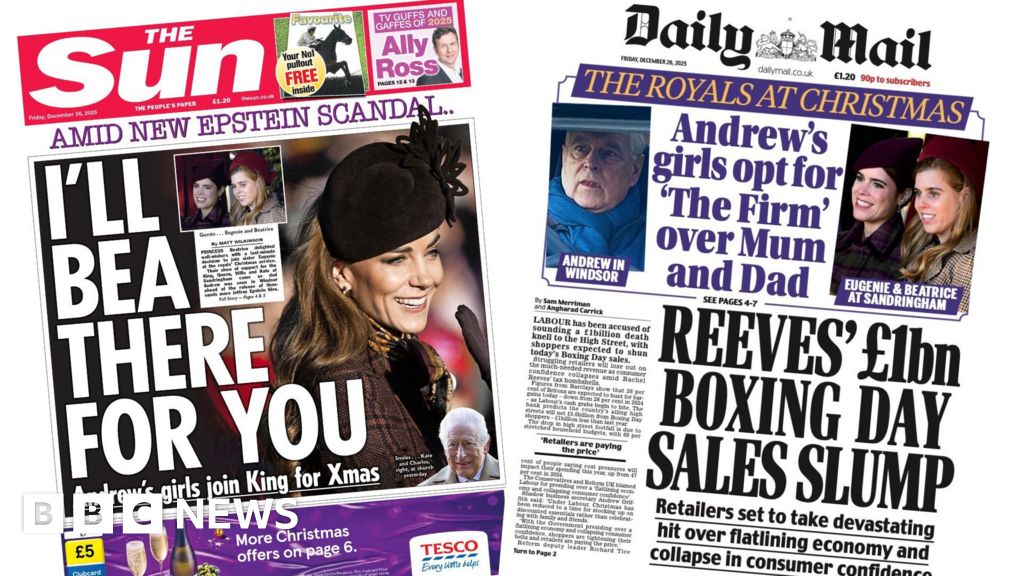
UK press highlights risks to consumer spending and household finances after budget measures and weak confidence: Barclays warns of a £1bn Boxing Day retail sales slump year‑on‑year as tax changes have 'stretched household budgets'. The Times flags that a faster, computer‑based property valuation method could overvalue homes by up to £30,000, potentially making thousands more properties liable for the newly announced mansion tax, which could pressure UK housing markets and household liquidity. Investors should monitor UK retail names for near‑term earnings/traffic downside and assess potential valuation and demand effects on residential property exposure.
Market structure: The near-term winners are defensive staples and banks that can earn higher net interest income (Barclays/BCS cited) while discretionary retailers and listed property portals/housebuilders face immediate demand compression from tax-driven wallet stress. Competitive dynamics favor low-price, omnichannel retailers and grocery chains (market share shifts away from full-price fashion and department stores); house price re-rating from a formulaic “mansion tax” roll‑out shifts margin tailwinds into downside for premium dealers. Cross-asset: expect GBP softness on weaker consumer prints, compression in UK real estate equities, wider credit spreads for sub-investment grade retail names, and mixed gilt action (lower inflation could pull yields down in 3–12 months while fiscal risks can spike them).
Risk assessment: Tail risks include rapid expansion of tax liability by +£30k valuation error leading to a materially lower top‑end housing demand (low‑probability but high‑impact), a consumer credit uptick raising delinquencies, or Bank of England rate surprises. Immediate (days): retail sales volatility and headline GBP moves; short-term (weeks–3 months): earnings downgrades for retailers/housebuilders; long-term (quarters): structural real estate repricing and persistent lower consumer confidence. Hidden dependencies: consumer credit card utilisation, retailer inventory levels, and automated valuation model (AVM) calibration errors. Key catalysts: ONS AVM guidance, next CPI prints, Bank of England minutes, and Q4 retail earnings (Jan–Feb).
Trade implications: Tactical: short UK discretionary/department-store basket (Next NXT.L, MKS.L) and buy GBPUSD downside; size 2–3% notional, horizon 1–3 months, stop-loss +6% adverse. Relative value: pair long BCS 2–3% vs short MKS.L 2% over 3–6 months to capture margin resilience in banking vs retail squeeze. Options: buy 3‑month put spreads on FTSE 100 consumer retail-heavy names (strike width 5–8%, funded by selling nearer-term calls) to limit cost while expressing downside. Rotate into staples (TSCO.L) and cash if consumer data deteriorates.
Contrarian angles: Consensus may overstate permanent retail demand loss — if sales timing shifts, select omnichannel retailers could recover; establish small opportunistic long in Rightmove RMV.L (1–2% position) only after a >20% drawdown from current levels and positive ONS clarification. The market may also underprice a rapid yield decline if fiscal receipts pick up from higher property taxes; consider tactical (0.5–1%) long in 5‑year gilts if yields breach below a 3.5% threshold on falling CPI prints. Monitor ONS AVM corrections and Bank of England speeches as day‑0 re‑rating triggers.
AI-powered research, real-time alerts, and portfolio analytics for institutional investors.
Request DemoOverall Sentiment
moderately negative
Sentiment Score
-0.45
Ticker Sentiment
