Delegations from the US, Israel, and Hamas are commencing indirect talks in Egypt to finalize President Trump's 20-point Gaza ceasefire plan. While Hamas has conditionally agreed to hostage release and ceding governance, its response notably omits disarmament and international oversight, leaving the outlook for a comprehensive agreement uncertain. President Trump has issued a stark warning to Hamas of "complete obliteration" should it refuse to relinquish power, even as Israeli Prime Minister Netanyahu maintains that full plan implementation is contingent on the release of all hostages, amid continued Israeli strikes in Gaza.
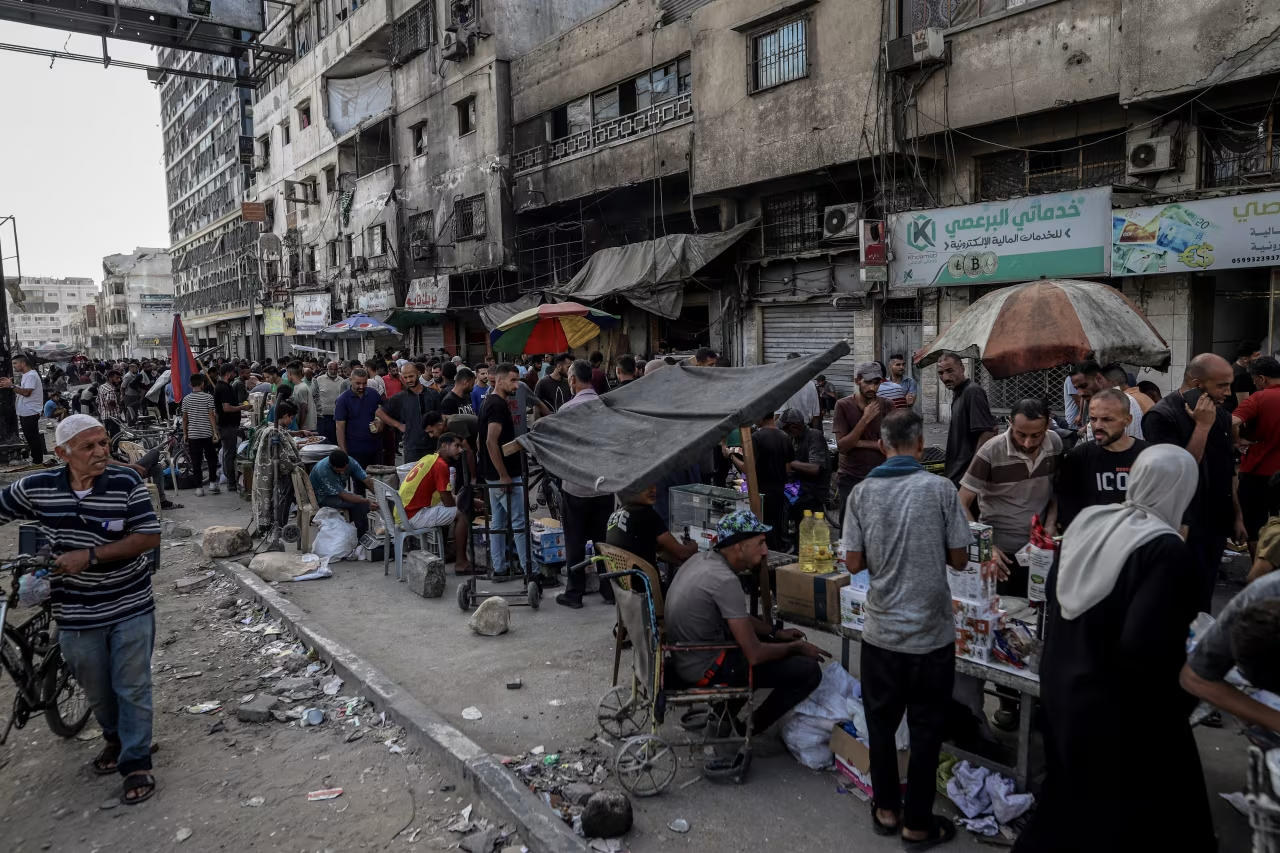
Where things stand • Delegations from Hamas, Israel and the United States are set to hold talks in Egypt starting tomorrow in hopes of finalizing an agreement based on US President Donald Trump’s 20-point Gaza ceasefire plan. • Trump told CNN Hamas faces “complete obliteration” if it refuses to cede power in Gaza, and he is also heaping pressure on Israel to move forward with the proposal. The president expects negotiations to take “a couple of days,” he said. • Trump called on Israel to temporarily halt its bombing of Gaza, but dozens of people have been killed in Israeli strikes over the weekend, according to hospitals in the enclave. Palestinians spoke to CNN about devastation on the ground and their tempered optimism for a truce. It's just after 10 p.m. in Gaza. Here are some of today's key headlines We’ve been closely tracking a flurry of Gaza ceasefire diplomacy, with negotiators now headed to Egypt for talks on President Donald Trump’s 20-point proposal to end the war between Israel and Hamas. We’re also hearing from Palestinians in Gaza, who have voiced tempered optimism about a truce but say Israeli strikes are still devastating the enclave. If you’re just joining us, here’s a roundup of the day’s news: • Who will attend the talks: Negotiators from the US, Israel and Hamas will be part of the discussions, and indirect talks between Israel and the militant group are expected to start tomorrow, sources tell CNN. Israel confirmed its delegation will depart for Egypt Monday, but said it will be led remotely by the country’s minister of strategic affairs. • Trump’s stark warning for Hamas: Trump told CNN yesterday that Hamas faces “complete obliteration” if the group refuses to cede power in Gaza. But he was upbeat on the prospect of striking a deal when speaking to reporters at the White House today, saying negotiations are already going “very well” and that he expects the Egypt talks to take “a couple of days.” • On the ground in Gaza: Some Palestinians have noted a decrease in the intensity of Israeli strikes today, after Trump claimed this weekend that Israel had temporarily stopped bombing the enclave. But Gaza hospitals said at least 15 more people were killed today and dozens of others were killed Saturday by Israeli strikes. • Meanwhile, key official emerges: Hamas’ chief negotiator, Khalil Al-Hayya, was seen in a video for the first time since the Israeli assassination attempt in Doha nearly one month ago. Al-Hayya is set to head the Hamas delegation for discussions about Trump’s ceasefire proposal, according to an Egyptian official. Watch: Trump says ceasefire talks could take "a couple of days" US President Donald Trump spoke to reporters earlier today at the White House, saying negotiations on the Gaza ceasefire deal are going “very well.” Trump described his 20-point ceasefire proposal as a “great deal” for Israel and “the entire Arab world.” Trump said the deal does not need any further flexibility and that the hostages released by Hamas under the agreement would need to come back “almost immediately.” Remember: Indirect talks between Israel and Hamas are set to start tomorrow in Sharm el-Sheikh, Egypt, according to an Egyptian official and three Israeli sources. Negotiators, including a US delegation, are headed to Cairo now. CNN’s Tal Shalev contributed reporting to this post. Israeli delegation will depart Monday for ceasefire talks The Israeli delegation for this week’s negotiations in Sharm el-Sheikh, Egypt, will depart for the talks Monday, according to Israeli Prime Minister Benjamin Netanyahu’s office. We reported earlier that Minister of Strategic Affairs Ron Dermer will lead the Israeli delegation. According to two Israeli sources, he will do so remotely, not travel to Egypt. The talks will involve top officials from Hamas and the US. Remember: The sides are trying to finalize an agreement based on President Donald Trump’s 20-point ceasefire plan, which would lead to the release of Israeli hostages. This post has been updated with additional information about Dermer leading talks remotely. Photos: Scenes from Gaza as Palestinians await news on ceasefire talks Our live coverage today has often focused on the flurry of diplomatic efforts surrounding US President Donald Trump’s ceasefire proposal for Gaza, but we also continue to monitor the situation on the ground in the enclave. CNN spoke with Palestinians today who said Israel’s bombardment seemed to lighten at least somewhat ahead of indirect talks tomorrow with Hamas. But dozens more people have still been wounded or killed in Israeli strikes over the past 48 hours, according to Gaza hospitals. Here are some scenes from around the enclave today: Some Palestinians note decreased intensity of Israeli bombardment today Some residents in Gaza have reported a decrease in Israeli strikes today, as negotiators prepare to meet in Egypt for ceasefire talks. While the relative calm has offered brief respite for the Palestinians CNN spoke with, they said they can still hear explosions and are cautious in their optimism. Ismail Zaydeh, who is currently sheltering at Gaza Port, said he heard airstrikes around dawn, including around Gaza City’s Tel al-Hawa and al-Sabra neighborhoods and the beach encampment west of the city. Hatem Abu Rahma, who had been living in Gaza City’s Al-Shifa neighborhood but traveled an hour away to the Al-Saraya area for his safety, told CNN the situation across the enclave feels “much calmer” this weekend in comparison with Friday. Asmaa Ziyad from Gaza City’s Al-Sahaba neighborhood also noted a change, saying: “Yesterday and the night before, there were many airstrikes, but the bombardment is lighter than it was two days ago. We still hear the sounds of aircraft and distant explosions, but not like before.” Abu Rahma, from the Al-Shifa neighborhood, said he returned there over the weekend but found the situation “still dangerous.” Deadly strikes: On Friday, US President Donald Trump called on Israel to “immediately stop the bombing.” But Israeli airstrikes have continued to batter the enclave, with the number of dead and injured rising by the dozens this weekend. US defense secretary says Israel can "finish the job" if Hamas doesn't stand by ceasefire terms We’re hearing from another Trump administration Cabinet official, after we brought you updates on Secretary of State Marco Rubio’s remarks earlier. If Hamas doesn’t follow through with the terms of a ceasefire deal, “Israel can finish the job,” US Secretary of Defense Pete Hegseth said on FOX News’ “The Sunday Briefing.” “Israel can go in there and make sure Hamas is obliterated,” Hegseth said. Hamas chief negotiator Khalil Al-Hayya seen in video for first time since Israeli assassination attempt Hamas’ chief negotiator, Khalil Al-Hayya, was seen in a video for the first time since the Israeli assassination attempt in Doha nearly one month ago. In the two-and-a-half-minute video, only Al-Hayya’s head and chest can be seen, and it’s unclear if he is suffering from any injuries as a result of the earlier attack. It’s also unclear where the video was shot. According to Hamas, the video was recorded on Saturday. Al-Hayya mourns his son, who was killed in the Israeli strike on September 9, and says, “We are heartbroken over the loss of thousands in Gaza. God has honored us by counting among the martyrs our sons and grandchildren.” The strike hit a residential building near the center of Doha, targeting senior Hamas leaders, including Al-Hayya and others. The Israeli strike drew international condemnation, including from US President Donald Trump. Al-Hayya is set to head the Hamas delegation for discussions about Trump’s 20-point ceasefire proposal, according to an Egyptian official. Israeli foreign minister commends Trump's "huge mission" to release hostages Israeli Foreign Minister Gideon Sa’ar has commended US President Donald Trump’s “huge mission” to secure the release of the remaining captives in Gaza while voicing his optimism that a hostage deal could be close. Israel is now working to implement the first step of the Trump administration’s ceasefire plan, which focuses on the release of Israeli hostages, he added. Three Israeli anti-war activists who tried to break through Gaza border freed from jail Three Israeli anti-war activists have been released from detention and placed under house arrest after attempting to break through the Gaza border, a spokesperson for the their network, Mesarvot, said Sunday. Itamar Greenberg, Roman Levin and Roy Elani were arrested and detained in Beersheba District Court after crossing briefly into the Gaza border on Friday. The activists are part of a small but loud group of Israelis who have decried their country’s military actions in Gaza and who have marched toward the Gaza fence for weeks in solidarity with the Sumud Flotilla, aiming “to break the siege on Gaza.” “We demanded an immediate end to the genocide and ethnic cleansing carried out by Israel,” a video posted to Greenberg’s Instagram on September 19. Greenberg, 19, is a conscious objector, having refused to enlist for military service, which is compulsory for most Jewish Israelis - and some minorities - over the age of 18. Greenberg was in and out of prison over the last year for objecting to serving in the military. He served a total of 197 days over five consecutive sentences before being released in March 2025. He said his refusal to serve came at the “culmination of a long process of learning and moral reckoning.” “The more I learned, the more I knew I couldn’t wear a uniform that symbolizes killing and oppression,” he told CNN earlier this year, explaining that Israel’s war in Gaza solidified his decision to refuse. “There is genocide,” he said. “So we don’t need good reasons (to refuse).” The Israeli government has vehemently denied accusations of genocide. For context: An independent United Nations inquiry concluded for the first time last month that Israel has committed genocide against Palestinians in Gaza and that the country’s top leaders have incited genocide, in what it described as the “most authoritative UN finding to date.” CNN’s Eugenia Yosef contributed to this report. Trump's team "convinced" ceasefire plan is possible, Israeli opposition leader says Israeli opposition leader Yair Lapid said today that US President Donald Trump’s team is “convinced” their ceasefire proposal is not only possible, but “should happen.” “This deal was shaped thanks to President Trump, and despite (Israeli Prime Minister) Benjamin Netanyahu. I saw yesterday Netanyahu trying, as usual, to steal the credit for it,” Lapid added. The opposition leader went on to say that Netanyahu has “no political impediment” to finish what Trump started, before adding: “This deal can be done; this deal must be done.” Rubio says Hamas' response to US ceasefire proposal "an enormous achievement" More now from US Secretary of State Marco Rubio, who was also speaking earlier today on ABC’s “This Week.” He said the administration’s hope is to have “90 percent” of negotiations completed by the time White House officials arrive in Cairo. As we’ve reported, delegations from the US, Israel and Hamas are heading to Egypt to discuss the proposal, and indirect talks between Israel and Hamas are expected to start Monday, according to an Egyptian official and three Israeli sources. Rubio said that while he does not fully trust Hamas leaders, there is still progress being made during negotiations. When pressed on if hostages will be released as soon as this week, Rubio said that the administration is hoping it happens “as quickly as possible.” Rubio says administration hopeful on releasing hostages in Gaza "very quickly" US Secretary of State Marco Rubio has been on the Sunday political shows today and we can bring you some of his remarks. Securing the release of the Israeli hostages in Gaza is “priority number one” for the Trump administration as it works to reach a deal with Hamas for a ceasefire in Gaza, Rubio told NBC’s “Meet the Press” Rubio said it’s a goal the administration believes “we can achieve something very quickly on,” specifying that the release would be “in exchange for Israel moving back to” the initial withdrawal line outlined in President Donald Trump’s proposed ceasefire plan, “which is basically where they stood at the middle part of last month of August.” “Even as I speak to you now, there are people meeting on that,” Rubio added. Here's what to know about Trump's son-in-law Jared Kushner As we’ve been reporting, negotiators from the US, Israel and Hamas are heading for Egypt for talks on a Gaza ceasefire. Indirect talks between Israel and Hamas will take place in Sharm el-Sheikh tomorrow. The US delegation will include special envoy Steve Witkoff, and also Jared Kushner, who is US President Donald Trump’s son-in-law. After leaving the White House in 2021, Kushner launched a private equity firm, Affinity Partners, which received $2 billion from Saudi Arabia’s sovereign wealth fund. The UAE and Qatar have also invested large amounts into his firm. These deals came shortly after Kushner helped lead Middle East policy during the first Trump administration, including the Abraham Accords, which normalized ties between Israel and several Arab states. Kushner has denied these investments are a conflict of interest. Critics from across party lines and human rights organizations argue that Kushner continues to profit from relationships he built while in public office, renewing questions about whether his financial ties with Riyadh and other Gulf players could influence US policy under his father-in-law. His firm invests heavily in Israeli companies, and Kushner praised the “very valuable” potential of Gaza’s “waterfront property” last year, suggesting that Israel should move Palestinians “out and then clean it up” — raising further questions about his impartiality in acting as a mediator as he re-enters diplomatic circles. Some Gaza aid flotilla members have suffered "serious abuses" in Israeli custody, lawyers say Detained activists of the recently intercepted Gaza-bound aid flotilla have suffered “serious abuses” in Israeli custody, including being denied access to medication and – for some – physical violence, according to a legal team representing the group. The claims come days after the same lawyers said some detained activists had been forced to “kneel with their hands zip-tied for at least five hours.” Adalah, a legal organization for Arab minority rights in Israel, said in a statement Sunday that their attorneys had met with more than 80 participants of the flotilla over the past two days at Ktziot Prison in southern Israel. According to the testimonies of these individuals, Adalah said that, as of Saturday, participants were denied access to essential medications, including prescriptions for conditions such as high blood pressure, heart disease and cancer. “The participants are detained in overcrowded cells, and some participants were forced to sleep on the floor under harsh and unsanitary conditions,” Adalah said. “Several participants reported that they were interrogated by unidentified personnel and others reported mistreatment and abuse by prison guards.” Adalah said that Israeli authorities “used physical violence against some detainees, with at least one participant sustaining injuries to his hands.” Other members of the flotilla were blindfolded and handcuffed for prolonged periods, Adalah said. Israel’s Foreign Ministry said today that the claims of mistreatment are “brazen lies.” “All the detainees’ legal rights are fully upheld,” the ministry posted on X. In a statement to CNN, the Foreign Ministry also said, “Of course they are receiving food, water and medication, and they are not mistreated.” Hamas faces "complete obliteration" if it insists on staying in power, Trump says US President Donald Trump has told CNN Hamas faces “complete obliteration” if the group refuses to cede power and control of Gaza, amid ongoing efforts to push forward his proposed ceasefire plan. “Complete Obliteration!” Trump told CNN’s Jake Tapper when asked via text message yesterday what would happen if Hamas insists on staying in power. Tapper pressed the president on Hamas’ response to his 20-point ceasefire proposal, citing Sen. Lindsey Graham’s interpretation that Hamas had effectively rejected the plan by insisting on “no disarmament, keeping Gaza under Palestinian control and tying hostage release to negotiations.” “Is he wrong?” Tapper asked. “We will find out. Only time will tell!!!” Trump responded. The president said he expects clarity “soon” on whether Hamas is genuinely committed to peace. “Yes on Bibi,” Trump said, when asked if Israeli Prime Minister Benjamin Netanyahu is fully on board with ending the bombing campaign in Gaza and supporting the president’s broader vision. Trump added that he is hopeful his ceasefire proposal will become a reality and emphasized that he’s working hard to achieve it. What Hamas has agreed to — and what it hasn't While we await delegations from Hamas, Israel and the US to continue talks in Egypt, let’s take a look at how Hamas responded to parts of US President Donald Trump’s ceasefire plan. The militant group’s response opened the door to potential negotiations to finalize a deal, and Trump quickly hailed it as victory, saying Hamas was “ready for lasting peace.” But the response was conditional, and it entirely left out some of the key parts of Trump’s proposal. Crucially, it accepted two of the most important demands of the Trump plan: the release of all of the hostages at the beginning of the ceasefire and Hamas ceding governance in Gaza. Hamas agreed to the “exchange formula” laid out in the plan: all 48 remaining hostages for 250 Palestinian prisoners and 1,700 Palestinians from Gaza detained after October 7. The militant group also said it was willing to hand over power in Gaza to independent Palestinian technocrats, closely mirroring the language in the US plan. But missing in Hamas’ response is any mention of the international oversight committee led by Trump, called the “Board of Peace,” that’s supposed to supervise the local Palestinian governance. It’s unclear if they accept this oversight or not. Hamas’ response also fails to address the issue of disarmament: a key condition of the Trump proposal and a demand of the international community. Hamas has repeatedly refused to disarm. The Hamas statement only says that “other issues” mentioned in the Trump plan “will be discussed through a comprehensive national Palestinian framework.” Hamas also insists that it will be a part of this framework, defying the Trump proposal’s demand that it “not have any role in the governance of Gaza, directly, indirectly, or in any form.” These issues — and the lack of clarity around Hamas’ position — mean the outlook for potential negotiations to finalize a deal are not certain. Trump may be celebrating, but there are still delicate talks ahead on some of the most sensitive issues. Pope Leo concerned by "antisemitic hatred" and saddened by suffering in Gaza Pope Leo XIV said Sunday he is concerned about the rise of “antisemitic hatred” in the world while referencing the synagogue attack in Manchester, northern England, earlier this week. Leo also said he continues to be “saddened” by the suffering of Palestinian people in Gaza. Leo, the first Amercian pope, acknowledged that “some significant steps” have been taken in ceasefire negotiations, which he hoped would achieve the “desired results as soon as possible.” “I ask all those in positions of responsibility to commit themselves to this path, to bring about a ceasefire and to release the hostages,” Leo said. Deadly attacks continue in Gaza, with at least 15 people killed since dawn, authorities say At least 15 Palestinians have been killed in Gaza since dawn today, hospital authorities said. Israeli strikes continue to batter the enclave, despite US President Donald Trump’s Friday call for Israel to “immediately stop the bombing” and as delegations from the United States, Israel and Hamas head to Egypt to discuss his ceasefire proposal. Indirect talks between Israel and Hamas are expected to start tomorrow in Sharm el-Sheikh, Egypt, according to an Egyptian official and three Israeli sources - as we reported earlier. At least 67 people were killed in Gaza yesterday as Israeli bombardment continued, hospital officials said. Seventeen – many of them children – were killed after a strike hit a home in Gaza City, which recorded most of the deaths in the enclave Saturday. The number of injured also continues to rise. More than 460 people were treated at Gaza City’s Al-Ahli Arab hospital Saturday, said Dr. Fadel Naim, who works there. “The medical teams are still fighting to save lives amid severe shortages of staff, supplies and medicines, and an overwhelming number of patients requiring urgent surgery,” he said. Meanwhile, at the Al-Shiffa Hospital in Gaza City, director Dr. Mohammad Abu Salmiya told CNN that there are few hospitals still operating in the city and they are able to provide only the minimum level of service. “The medical and humanitarian situation in Gaza City remains catastrophic in every sense of the word, he said. For context: More than 67,000 Palestinians have been killed since October 7, 2023, according to the latest figures from the Palestinian Ministry of Health. Many more have been left with life-changing injures, according to the ministry. In total, 169,583 people have been injured since the start of the war, it said Sunday. Global outrage has grown after two years of war in Gaza. It's a different story in Israel On a hot Friday morning in September, dozens of Israelis turned up at Gaza’s border fence – not as soldiers, but as dissenters. Their demand: an end to the siege they say is being carried out in their name. The activists, mostly Jewish Israelis, marched toward the fence, calling on the international community to sanction and isolate their country, to “stop the genocide and end the decades-long Zionist apartheid regime.” “We are fully aware that the government is not going to stop, so we are here to call on the world to boycott us, as ridiculous as it sounds,” Sapir Sluzker Amran, one of the participants, told CNN. Almost two years into the war in Gaza, Sluzker Amran represents a minority in Israel, and she is aware of it. “It’s a shame that we don’t have more people with us today, but I think we need to keep challenging our own society. … They’re in denial, and I think the best way to get out of this denial is to keep shocking them until everyone faces the horrible truth that we are committing genocide.” In September, an independent UN inquiry concluded for the first time that Israel had committed genocide against Palestinians in Gaza, a finding which the Israeli government has rejected. Only a short drive away, the extreme distance between the protesters’ view and that of most Israelis is made clear. Read the full story here. Israel will not move forward with Trump’s Gaza plan fully until all hostages freed, Netanyahu says Israeli Prime Minister Benjamin Netanyahu said today that he would not move forward with the entirety of the Trump administration’s ceasefire plan until all hostages are freed. “Only then will we proceed to any other clause,” Netanyahu added. He was speaking to Israel’s Heroes Forum, a group of families whose loved ones were killed during Hamas’ October 7 attacks or in the war in Gaza that followed. High-stakes ceasefire negotiations are set to commence in Egypt, centered on a 20-point US proposal, yet the prospects for a durable agreement are highly uncertain. While Hamas has conditionally agreed to the critical demands of releasing hostages and ceding governance to a technocratic body, its response critically omits any commitment to disarmament or the proposed international oversight committee—two fundamental pillars of the plan. This significant gap signals that core issues remain unresolved. The diplomatic environment is further charged by President Trump's ultimatum of "complete obliteration" for Hamas, contrasted with Israeli Prime Minister Netanyahu’s firm precondition that no further steps in the plan will be taken until all hostages are released. This dynamic creates a potential impasse. Despite a reported decrease in the intensity of Israeli strikes, bombardments and casualties have continued over the weekend, highlighting the extreme fragility of the situation on the ground and the chasm between diplomatic overtures and military reality. The high market impact score of 0.7 reflects the significant geopolitical risk, where a breakdown in talks could rapidly escalate the conflict and reverberate through regional stability.
AI-powered research, real-time alerts, and portfolio analytics for institutional investors.
Request DemoOverall Sentiment
mixed
Sentiment Score
-0.10
