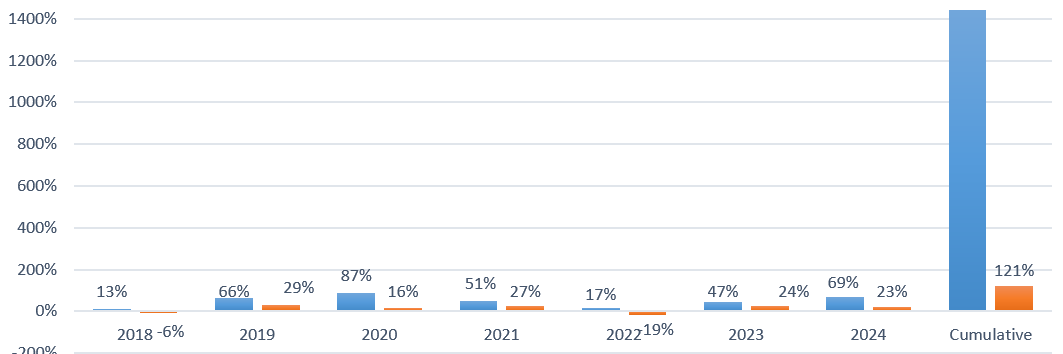
The author argues that despite November market pullbacks the fundamental backdrop favors risk assets—particularly AI leaders—forecasting the AI market to grow from $500B in 2027 to over $1T by 2030. He names a 2026 AI Top 10 (TSLA, AMD, META, GOOGL, ORCL, PLTR, AMZN, DELL, MRVL, MU) as compelling entry points after sharp corrections and projects the S&P 500 to reach 7,000–7,200 by early 2026 and 8,000 by year-end 2026. The piece is an analyst opinion with disclosed long positions in several mentioned names.
Market structure: AI leaders (META, GOOGL, AMZN, AMD, MRVL, ORCL, DELL, TSLA) are the primary beneficiaries as corporate AI spend and cloud compute demand shift share toward hyperscalers, AI-optimized silicon and enterprise software; I model a 2x TAM expansion to >$1T by 2030 implying 30–60% EPS uplift for top executioners over 2026–2030 versus peers. Losers are low-automation cyclical capital goods and margin-compressed on-premise vendors; pricing power will concentrate with those controlling training/inference stacks and data centers. Cross-asset: a sustained tech rally likely steepens the curve (higher real yields), compresses IG credit spreads, weakens USD in risk-on phases, and lifts copper and energy demand 5–12% over 12–24 months.
Risk assessment: Tail risks include an EU/US AI regulatory shock, accelerated export controls on advanced nodes, or a Fed shock that pushes the 10yr >4.0% (could cut growth multiples 15–25%). Near-term (days–weeks) momentum and sector rebalancing dominate; medium-term (3–12 months) depends on compute availability and Q2–Q4 guidance; long-term (2–5 years) is execution of stack monopolies. Hidden dependencies: Nvidia-equivalent bottlenecks (compute scarcity), TSMC capacity, and cloud margin squeeze from aggressive price competition. Key catalysts: large enterprise AI RFP wins, hyperscaler capex announcements, and Fed rate decisions.
trade implications: Direct plays — preferentially size longs in META, GOOGL, AMD and MRVL given asymmetric upside; use ORCL/DELL to de-risk with higher cash flow visibility. Pair trade — long ORCL vs short PLTR to capture execution/valuation dispersion; target relative outperformance of +25% in 6–12 months. Options — buy 9–12 month LEAPS 25–35% OTM on AMD/META and a 3-month SPX 7–10% OTM put spread as portfolio tail hedging around Fed dates. Entry: scale on any 10–18% pullback; take profits at +30–50% or if 10yr >4.0%/SPX down 12%.
contrarian angles: Consensus underestimates regulatory and supply chokepoints; markets may be pricing near-term AI monetization too quickly (consumer ad and AWS margins could lag by 4–8 quarters). Conversely, ORCL and DELL’s enterprise foothold looks underpriced relative to growth names if compute costs stay elevated—re-rating upside of 20–40% is plausible. Historical parallel: 2016–2018 AI infrastructure ramp showed multi-year capex-led revenue growth but with intermittent 20%+ drawdowns; expect similar volatility and opportunities for disciplined buy-the-dip entries.
AI-powered research, real-time alerts, and portfolio analytics for institutional investors.
Request DemoOverall Sentiment
strongly positive
Sentiment Score
0.70
Ticker Sentiment
