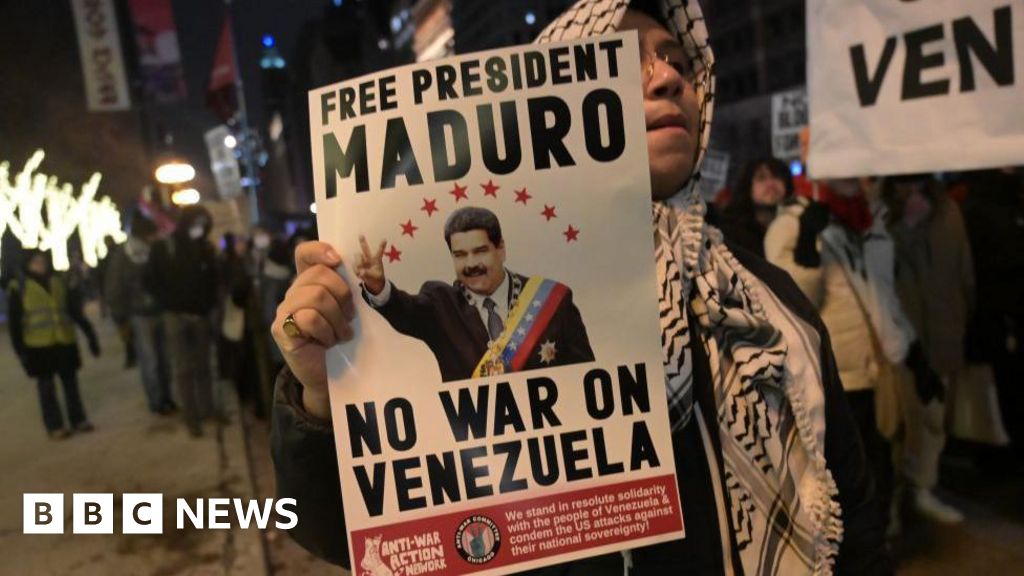
Venezuelan leader Nicolás Maduro was seized in an apparent US operation, brought to New York, and arraigned on superseding drug-trafficking charges to which he pleaded not guilty; US officials characterize the mission as supporting an ongoing criminal prosecution alleging large-scale narcotics trafficking. International-law experts and Maduro's lawyers contend the extraction likely violated the UN Charter and customary extradition norms and raises domestic constitutional questions about presidential war powers, creating legal and geopolitical risk that is politically significant but likely limited in direct market-moving consequences.
Market structure: The extrajudicial seizure increases political-risk premia for Latin America assets and raises the probability of short-term oil-supply shocks; expect a 3–8% implied-risk premium re-rating in regional EM and a 2–5% near-term upside to Brent if Venezuelan exports are further disrupted. Winners: US defense/ISR contractors (LMT, RTX, LHX) and global oil majors (XOM, CVX) who benefit from higher oil prices and renewed call-ups of security services. Losers: Venezuelan-linked sovereign credit, regional banks, and travel/insurance lines that underwrite tanker routes; local FX and sovereign spreads will widen until legal/diplomatic dust settles.
Risk assessment: Tail risks include retaliatory state or non-state action against US assets in Latin America, a protracted legal fight that triggers secondary sanctions, or a diplomatic rupture that persists >6–12 months; market shock scenarios could push Brent +15–25% and regional sovereign spreads +300–500bp. Immediate (days) risk is FX and commodity volatility; short-term (weeks) is widening EM credit and equity drawdowns; long-term (quarters) is a structural shift in US extraterritorial enforcement norms and alliance dynamics. Hidden dependencies: tanker insurance/P&I rates, shipping re-routing costs, and CDS liquidity that can amplify moves.
Trade implications: Tactical trades favor small overweight in energy and defense as geopolitical hedges and underweight/hedge in Latin America equities and bonds for 1–3 months. Use directional and volatility instruments—call spreads on WTI/Brent and put protection on Latin America ETFs—keeping sizes small (1–3% each) and predefined cutoffs. Watch legal filings and Treasury/State Dept. communications over the next 30–90 days as primary catalysts.
Contrarian angles: The market may overstate permanent supply loss from Venezuela—if Maduro’s removal eventually leads to asset re-opening, long-dated call exposure to XOM/CVX or to service names (SLB) could outperform over 12–36 months. Conversely, if courts rebuke US methods within 60–90 days, risk-on reversal could punish defense longs; asymmetric option structures (sell short-dated puts funded by long-dated calls) can exploit this skew.
AI-powered research, real-time alerts, and portfolio analytics for institutional investors.
Request DemoOverall Sentiment
mildly negative
Sentiment Score
-0.25
