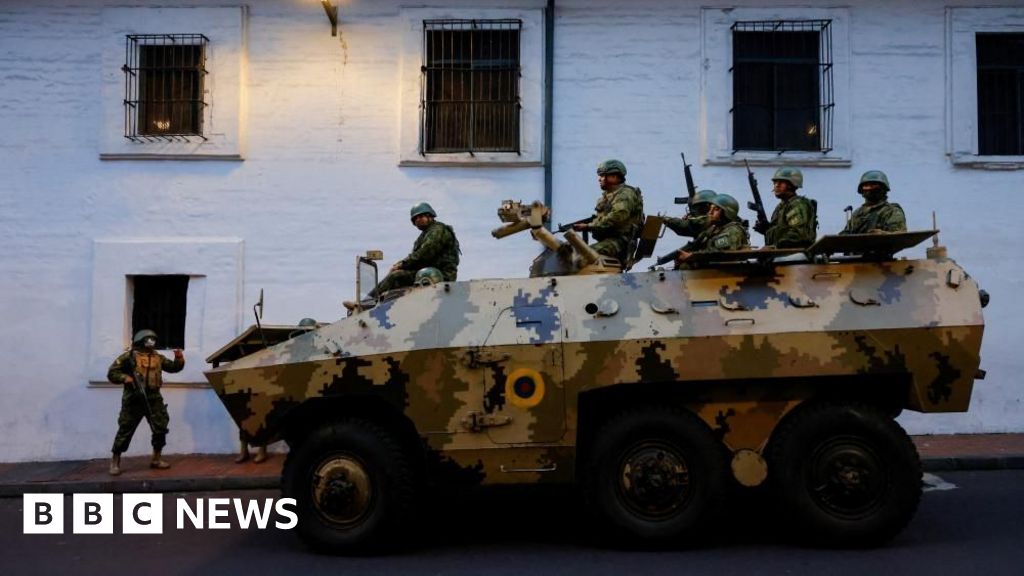
U.S. Southern Command and Ecuadorian forces have launched coordinated operations targeting designated terrorist organisations to disrupt illicit drug trafficking, with Ecuadorian officials warning that roughly 70% of the world's cocaine now flows through Ecuador's ports. President Daniel Noboa met U.S. Southern Command and Special Operations leaders to formalize information sharing and operational coordination at airports and seaports, following a temporary U.S. Air Force deployment to Manta and a domestic referendum blocking permanent foreign bases. The developments increase geopolitical and security risk for Ecuador and regional maritime/port routes and could presage expanded U.S. interdiction activity in the eastern Pacific and Caribbean.
Market structure: Short, targeted US-Ecuador counter-narcotics operations are a net positive for surveillance/ISR and prime defense contractors (LMT, RTX, LHX, GD) because near-term demand for maritime patrol, ISR intelligence-sharing, and base logistics increases visibility of 3–12 month contract opportunities. Ports and logistics providers in Ecuador/Colombia face higher inspection friction — container throughput could slow 5–15% regionally in stressed scenarios, raising short-term freight rates and insurance costs. EM sovereign credit (Ecuador, Colombia) and EM equity risk premia should reprice modestly; expect a 25–75bp widening in regional sovereign CDS if violence escalates.
Risk assessment: Tail risks include diplomatic backlash or escalation into broader strikes (low probability, high impact) that could trigger commodity shocks or refugee flows; worst-case yields on Ecuador sovereign USD bonds could spike >300bp in 1–3 months. Immediate risk (days) is localized market noise; short-term (weeks–months) is higher EM volatility and higher insurance/premia; long-term (1–3 years) is structurally higher US ISR spending benefiting defense suppliers. Hidden dependencies: increased US presence relies on Quito cooperation and domestic politics — referendum results show political fragility that can reverse access quickly.
Trade implications: Direct plays: overweight aerospace & defense (ITA, LMT) for 3–12 months and underweight EM sovereign debt (EMB) for 1–6 months. Options: favor 3–6 month call spreads on LMT/LHX to capture contract awards while buying 3-month put spreads on EMB or EEM as downside hedges. Sector rotation: shift 2–4% from EM equities (EEM) into defense ETF/contractors and selective shipping/container names (ZIM) that benefit from higher freight rates.
Contrarian angle: Consensus treats this as one-off law‑enforcement activity; I view it as a durable program that will drive 1–3 year procurement cycles for ISR and logistics — upside for primes likely underpriced. Conversely, EM selloff could be overdone; if CDS move >200bp without escalation, selectively buy dips in high-quality LatAm exporters (COL, COP producers) within 6–12 months. Unintended consequence: heavier US strikes may push trafficking to new routes, prolonging insecurity and creating persistent logistics premium.
AI-powered research, real-time alerts, and portfolio analytics for institutional investors.
Request TrialOverall Sentiment
mildly negative
Sentiment Score
-0.25
