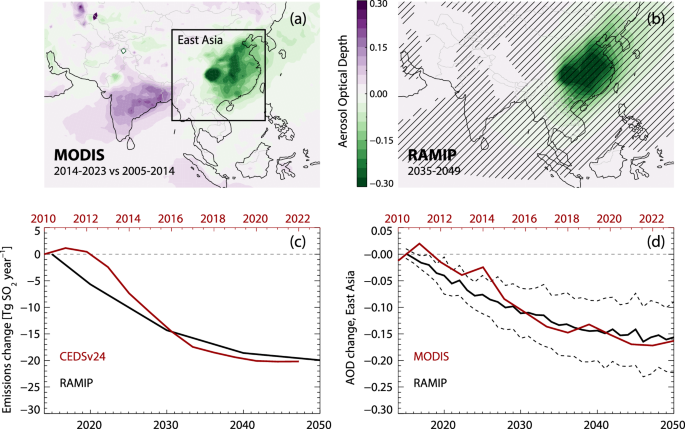
A new study leveraging Earth System Models indicates that East Asian efforts to reduce air pollution, specifically a 75% reduction in sulfate emissions since 2010, have significantly contributed to the accelerated global warming observed in the past decade. This aerosol cleanup has unmasked greenhouse gas-driven warming, adding approximately 0.07°C to global mean temperatures and accounting for a substantial portion (0.05°C/decade) of the 0.06°C/decade increase in the global warming rate since 2010, with pronounced effects in East Asia and the North Pacific. This highlights an unintended, yet material, climate consequence of regional air quality improvements.
A recent scientific study using eight Earth System Models provides compelling evidence that China's successful efforts to reduce air pollution have unintentionally accelerated global warming since 2010. The sustained 75% reduction in East Asian sulfate (SO2) emissions, a pollutant with a known atmospheric cooling effect, has unmasked underlying greenhouse gas-driven warming. This has resulted in a quantifiable global mean temperature increase of 0.07 ± 0.05 °C. The study attributes a warming rate of 0.05 °C/decade to this aerosol cleanup, accounting for a significant portion of the observed acceleration in the global warming rate from 0.18 °C/decade (1980-2009) to 0.25 °C/decade (2010-2023). The geographical pattern of this induced warming is concentrated over East Asia and the North Pacific, which corresponds with observed temperature anomalies and satellite-measured changes in the Earth's radiative balance. As the potential for further SO2 reductions in this region is now limited, this specific driver of accelerated warming is expected to become less prominent, shifting the focus to other factors like greenhouse gas emissions and aerosol changes from other regions.
AI-powered research, real-time alerts, and portfolio analytics for institutional investors.
Request DemoOverall Sentiment
moderately negative
Sentiment Score
-0.50
