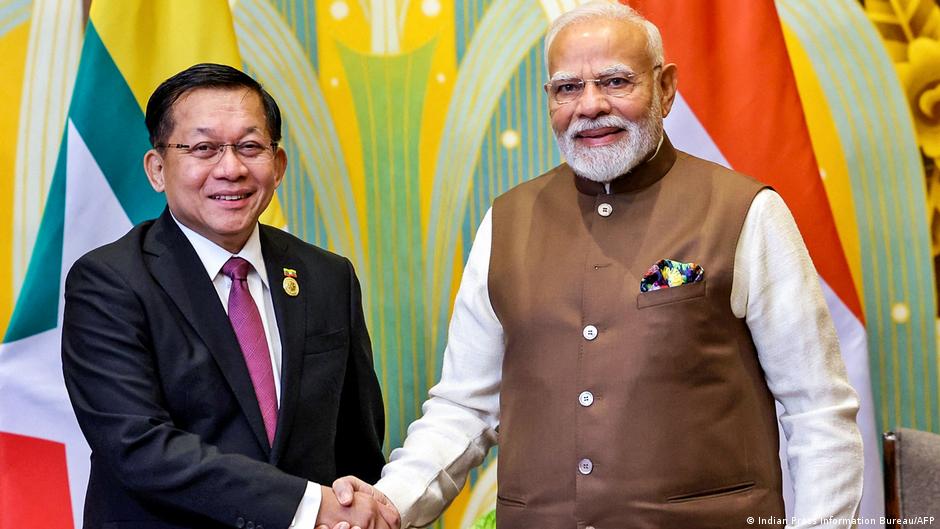
Myanmar President Min Aung Hlaing is on a five-day visit to India and will meet Prime Minister Narendra Modi on 1 June to discuss strengthening bilateral ties. The article also highlights a new climate report warning that India’s 11,000 km coastline faces an imminent climate risk and that average temperatures may rise by 1.5°C from 2021 to 2040. Separately, Karnataka’s Congress Party is preparing to name DK Shivakumar as chief minister as the state transitions leadership.
The Myanmar visit is less about optics than about India trying to secure a land-and-sea buffer on its eastern flank while China is distracted by its own regional overextension. The second-order trade is on strategic materials and border logistics: any incremental thaw that improves transport permissions, customs coordination, or policing along the frontier should disproportionately help Indian infrastructure, rail, and defense vendors with Northeast exposure, while reducing the probability of disruptive spillovers into Assam/Manipur supply routes. The real market signal is not a headline diplomatic boost; it is whether this visit precedes concrete cross-border commerce or security agreements within 1-2 quarters.
The Karnataka transition is a smaller but still relevant domestic policy catalyst because cabinet formation determines project pacing, not just political control. For markets, the key risk is administrative delay: even a few weeks of uncertainty can slow procurement, land approvals, and capex disbursement in a state that is important to India’s industrial and tech ecosystem. If the new team prioritizes welfare over infrastructure, contractors and capex-linked names could see near-term execution slippage, while any compromise settlement that stabilizes the coalition would reduce that overhang quickly.
The climate warning is the most underpriced medium-term theme in the package. A rising heat-and-coastline risk profile favors firms tied to water management, cooling, grid hardening, coastal infrastructure, and catastrophe-linked insurance pricing, while pressuring labor-intensive sectors with outdoor workforces and asset bases in vulnerable districts. The market is still treating climate adaptation as a policy narrative rather than a capex cycle; that mismatch could matter over the next 12-36 months as state budgets, municipal spending, and insurer retentions start to reprice physical risk.
AI-powered research, real-time alerts, and portfolio analytics for institutional investors.
Request TrialOverall Sentiment
neutral
Sentiment Score
-0.05
