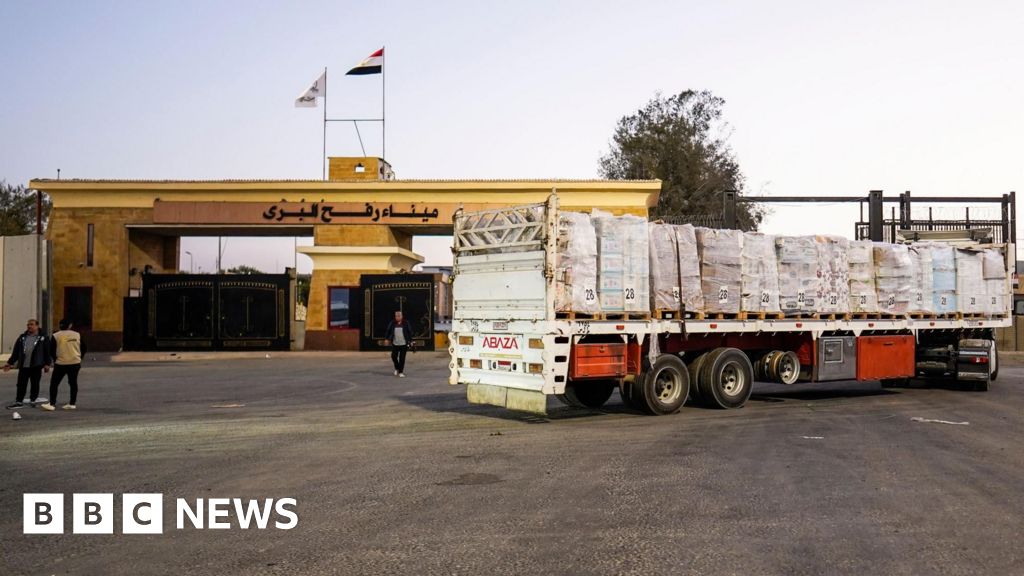
Israel has conditioned a limited reopening of the Rafah crossing to pedestrian passage on completion of a focused military operation to retrieve the remains of the last Israeli hostage, Master Sgt. Ran Gvili, with searches underway in northern Gaza east of the ceasefire 'Yellow Line'. The development, occurring amid US-led mediation on phase two of a Gaza peace plan, affects cross-border movement and humanitarian aid flows and sustains regional geopolitical risk after the Oct. 7, 2023 attacks (≈1,200 killed, 251 taken hostage) and the subsequent Gaza toll reported at roughly 71,650 deaths by the Hamas-run health ministry.
Market structure: The immediate winners are defense and security contractors (LMT, RTX, GD) and logistics/security-tech providers as any uptick in operations or renewed hostilities increases near-term procurement and services demand; losers are Israeli-exposed tourism, transport and small cap exporters and Egyptian border traders who bear the cost of a closed Rafah crossing. Supply/demand: humanitarian and cargo bottlenecks persist while pricing power for private security, air freight rerouting and insurance (war-risk premia) rises, placing upward pressure on freight rates and marine/air insurance spreads by an estimated +10–30% if the crossing stays restricted for >4 weeks. Cross-asset: expect short-term risk-off flows into USD, JPY, TLT and gold (GLD); oil is the key commodity risk — a regional escalation scenario could add +20–40% to Brent versus current levels, while options volatility across EM and Israel ETFs will spike.
Risk assessment: Tail risks include a wider regional war (Iran/Hezbollah involvement) that would drive oil >$100/bbl and EM equity drawdowns of 15–30%; probability low but payoff extreme. Time horizons separate immediate days (heightened vol, rapid FX and credit spread moves), short-term weeks/months (defense rerating, elevated insurance/freight costs, temporary Israeli economic drag), and long-term quarters/years (reconstruction spending if phase two proceeds). Hidden dependencies: US diplomatic timelines, reconstruction contract awards to Western firms, and families’ political leverage (hostage recovery) can rapidly reverse reopenings; catalysts include confirmation of Rafah reopening within 7–21 days or announced US/Gulf reconstruction funding packages within 30–90 days.
Trade implications: Tactical direct plays: establish modest longs in LMT and RTX (2% portfolio each) via 3–6 month 30–60% delta call positions to capture a 10–20% upside on escalation, and trim/hedge Israeli exposure by reducing EIS ETF weight by ~50% or buying 1-month ATM puts (size 3–5% notional) to guard against a 10–20% local selloff. Hedging/allocations: allocate 1–2% to GLD (spot or 3‑month call spread) and 2–3% to TLT for flight-to-quality protection; pair trade long TLT (2–3%) and short EEM (2%) for relative-value protection over 1–3 months. Entry/exit: open hedges immediately; scale defense longs on 5–10% pullbacks, reassess at 30/60/90-day diplomatic milestones.
Contrarian angles: Consensus underprices reconstruction upside — companies with heavy earth‑moving and materials exposure (CAT, CRH) could see multi‑quarter backlog upside if phase two advances; consider a small 1% catalyst-driven long in CAT over 12–24 months. The market may also be overreacting on Israeli equities given a conditional, limited Rafah reopening; if the body-recovery operation completes within 7–14 days and crossing reopens, expect a snap reversal—plan to trim puts and reduce TLT hedge within 48–72 hours of confirmed reopening.
AI-powered research, real-time alerts, and portfolio analytics for institutional investors.
Request DemoOverall Sentiment
moderately negative
Sentiment Score
-0.30
