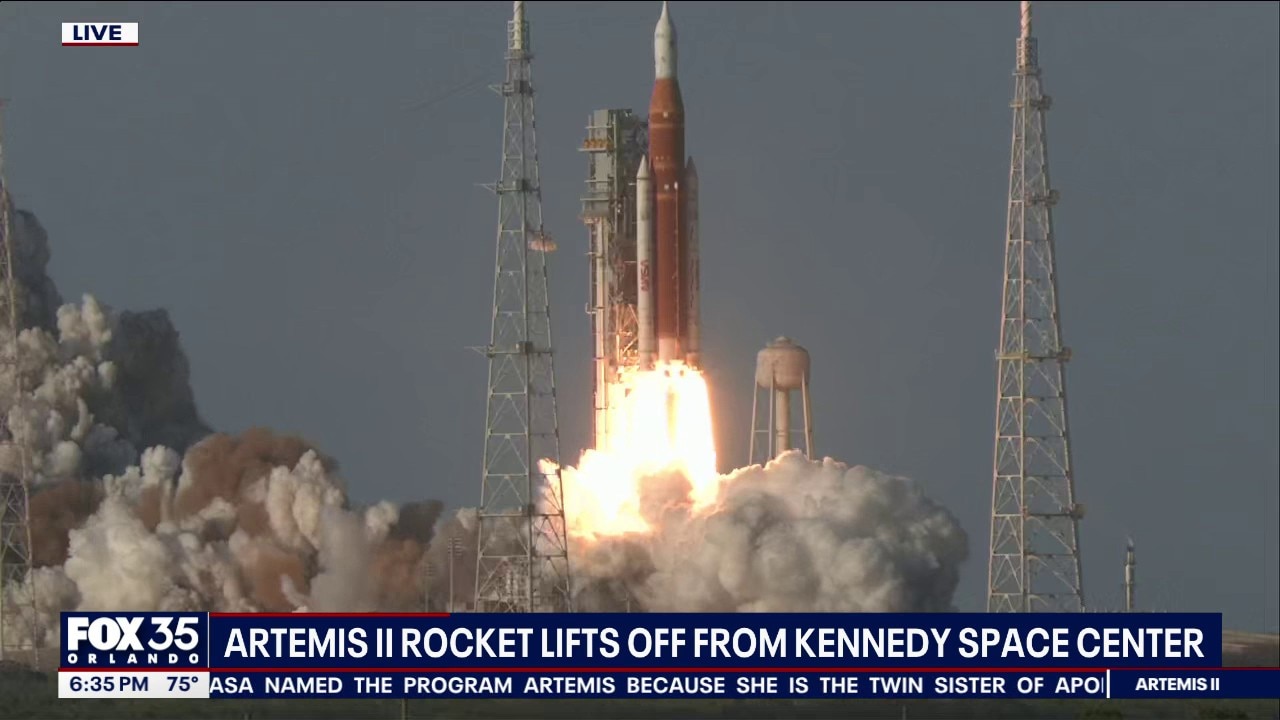
Artemis II successfully lifted off at 6:35 p.m. EDT on a roughly 10-day crewed mission around the Moon carrying four astronauts aboard the SLS/Orion stack; the vehicle mass was ~5.75 million lb and liftoff thrust ~8.8 million lb. On-orbit milestones achieved include SLS core stage separation, twin solid rocket booster separation, fairings jettison, and deployment of Orion’s four solar-array wings (≈63 ft wingspan; 15,000 cells per wing); Orion will perform perigee/apogee raises, a lunar flyby and a free-return reentry with peak heating up to ~3,000°F and a Pacific splashdown. Direct market impact is minimal, though asset owners should monitor aerospace/defense suppliers, launch-service counterparties and insurance exposures for any follow-on operational or supply-chain announcements.
The immediate market reflex will be to re-rate prime contractors and suppliers tied to deep‑space human missions (large systems integrators, propulsion and avionics vendors, and companies that supply radiation‑hardened electronics and high‑efficiency solar arrays). Expect a 1–3 day PR bump that fades unless followed by concrete follow‑on contract awards or program cadence commitments; real upside accrues to firms that convert PR into multi‑year funded workstreams, not to those trading on one successful flight.
Second‑order winners include specialty manufacturers with low‑volume, high‑margin capabilities (precision cryogenic plumbing, space‑qualified batteries, two‑axis gimbal mechanics) because program success reduces perceived technical risk and shortens procurement lead times for follow‑ons. Conversely, commercial LEO launchers and commoditized rideshare businesses are at risk of headline rotation away from private launches toward government heavy‑lift and sustained lunar infrastructure spending — momentum capital may reallocate into defense primes and suppliers with NASA/ESA pedigree.
Near‑term tail risks are binary: an anomaly during Earth‑return or service‑module issues would materially reset funding narratives and award timelines over 3–12 months. Medium‑term catalysts to watch are explicit multi‑year NASA procurement schedules, congressional appropriations tied to election cycles, and any public/private teaming announcements that move program revenue from “potential” to “contracted.”
Contrarian read: the market likely overweights program symbolism and underweights cadence constraints — heavy‑lift architectures are expensive and low‑rate, so real commercial industrialization will be driven by smaller, repeatable award flows (logistics, habitats, power). The best asymmetric opportunities are in mid/small caps that win discrete subsystems for follow‑on missions; the primes are already largely priced for a baseline NASA budget that still must be appropriated year‑by‑year.
AI-powered research, real-time alerts, and portfolio analytics for institutional investors.
Request DemoOverall Sentiment
neutral
Sentiment Score
0.05
