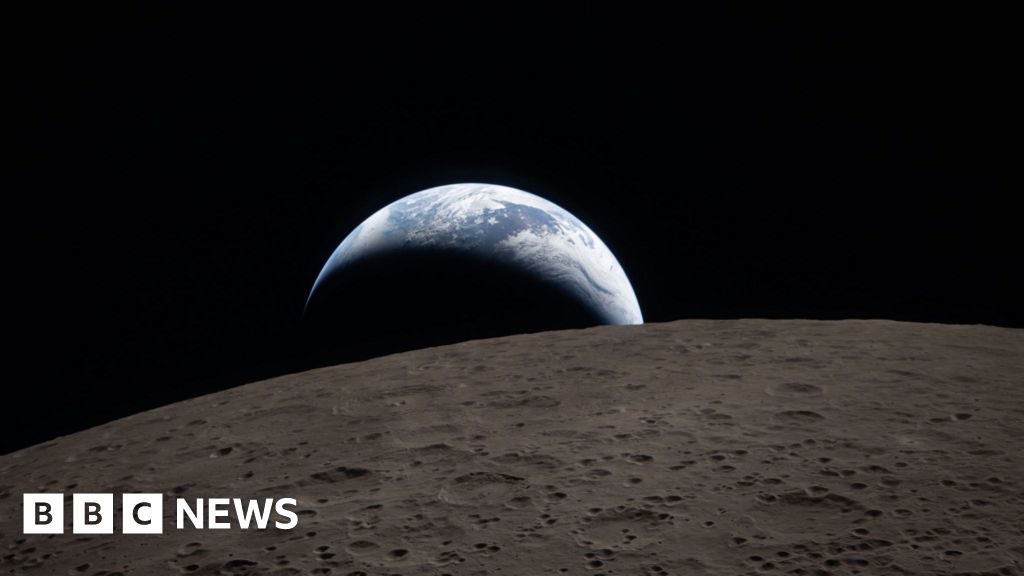
NASA released the first photographs from the Artemis II six-hour Moon fly-by — notably an 'Earthset' and a solar eclipse image (one photo taken through the Orion window at 18:41 EDT). The images draw a deliberate parallel to Apollo 8's iconic Earthrise and serve primarily as scientific/PR milestones; astronauts captured photos during a radio-silent period behind the Moon. There are no direct financial figures or market implications; expected market impact is negligible.
The successful Artemis II fly-by materially reduces execution uncertainty around the near-term lunar architecture and increases the probability of incremental NASA and DoD spend flowing to prime contractors over the 12–36 month window. That flow will skew to companies owning flight hardware, deep-space avionics, and mission integration — not to consumer-facing “space” publicity plays; expect revenue uplift in single‑digit percent terms for primes but high-margin follow‑on sustainment and sensor packages that compound FCF over multiple years.
Second-order supply‑chain effects will emerge in propulsion, radiation‑hardened electronics and deep‑space comms: qualifying small-batch components and radiation-hard semiconductors typically lengthens lead times to 12–24 months and allows suppliers to charge 15–30% higher engineering premiums versus commercial production. This widens margins for specialist suppliers but also concentrates program risk — a single parts bottleneck can delay multi-month deliveries and trigger contract renegotiations.
Market and media effects are front‑loaded: imagery drives retail and institutional attention that can accelerate private capital into space startups and fuel short-term equity re-ratings, but contractual cash flow and award timing (NASA contract awards, FY appropriations) are the true value drivers over 6–24 months. Tail risks that would reverse the optimism are classic: a high‑visibility anomaly or budget retrenchment tied to macro stress would compress multiples rapidly; monitor upcoming appropriation votes and scheduled contract award dates as the primary catalysts.
AI-powered research, real-time alerts, and portfolio analytics for institutional investors.
Request DemoOverall Sentiment
neutral
Sentiment Score
0.00
