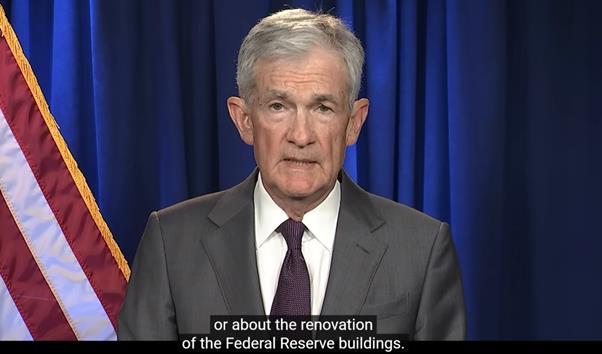
Fed Chair Powell's unusually direct public rebuke of the White House over central bank independence has so far produced little market reaction, with the dollar index marginally higher and markets largely pricing out near-term easing. Economists highlight benign December inflation and expect Fed cuts in March and June per James Knightley, while fiscal measures and tariff policy—including a possible Supreme Court ruling on emergency tariff powers next week—pose upside inflation risks. In Europe, data point to accelerating German activity (forecasts: 0.9% in 2026, 1.9% in 2027) that has pushed markets to largely price out ECB easing, and central-bank previews elsewhere include Romania holding at 6.5% until May and a potential large Turkish cut (guidance around a 150bp cut to 36.5%, with downside risks).
Market structure is tilting toward a reflation-lite regime: benign core inflation and Fed talk of March/June 25bp cuts (consensus markets pricing near 0–5bp before summer) favor longer-duration assets and rate-sensitive consumer cyclicals if cuts materialize. Winners: US consumer discretionary (XLY), homebuilders (XHB), agency MBS (MBB) and European cyclicals (EWG) if German fiscal/defence spending ramps; losers: short-duration money-market proxies and defensive staples (XLP) underperform cyclicals on lower real rates and tariff relief. Cross-asset: a dovish Fed → lower USD, steeper yields near-term on risk rallies then lower long yields once cuts are priced; gold (GLD) is a convex hedge if policy/political risk rises; oil remains capped absent geopolitical shocks but is highest tail-risk exposure.
Key risks: low-probability/high-impact shocks include a Supreme Court ruling forcing tariff reinstatements or a visible political takeover of Fed independence—either could spike core inflation expectations and USD volatility. Time horizons: immediate (next 7–14 days) — Supreme Court and labor/tariff headlines; short-term (1–3 months) — Fed decision dynamics and incoming PCE; medium (3–12 months) — fiscal measures (MBS purchases, tariff reductions) and German capex translating into growth. Hidden dependencies include muted consumer response to transfers and the lag from defence-capex into inflation.
Trade implications: bias to staged duration (TLT) and MBS (MBB) to front-run cuts, overweight European cyclicals (EWG/DAX) to capture Germany 0.9% 2026 GDP pickup and defence spending, and a tactical long XLY vs short XLP pair into tariff-relief scenarios. Use options to asymmetrically hedge: 3–6 month GLD call spreads as insurance and 2–3 month call spreads on XHB to lever potential reopening of mortgage affordability from tariff/refund tailwinds.
Contrarian view: consensus underestimates Europe’s rapid fiscal-to-real-economy transmission — if German industrial orders and PMIs print > consensus for two consecutive months, rotate into levered German industrials and exporters; conversely the market is underpricing Fed cut probability (market <5bp vs analyst 50bp by June), so modest long-duration stakes are underdone. Trigger thresholds: add duration/MBS if core PCE ≤2.5% in next print or cut exposure if 10yr >4.25% or tariff rollback probability falls <20% after the Court ruling.
AI-powered research, real-time alerts, and portfolio analytics for institutional investors.
Request DemoOverall Sentiment
neutral
Sentiment Score
0.10
