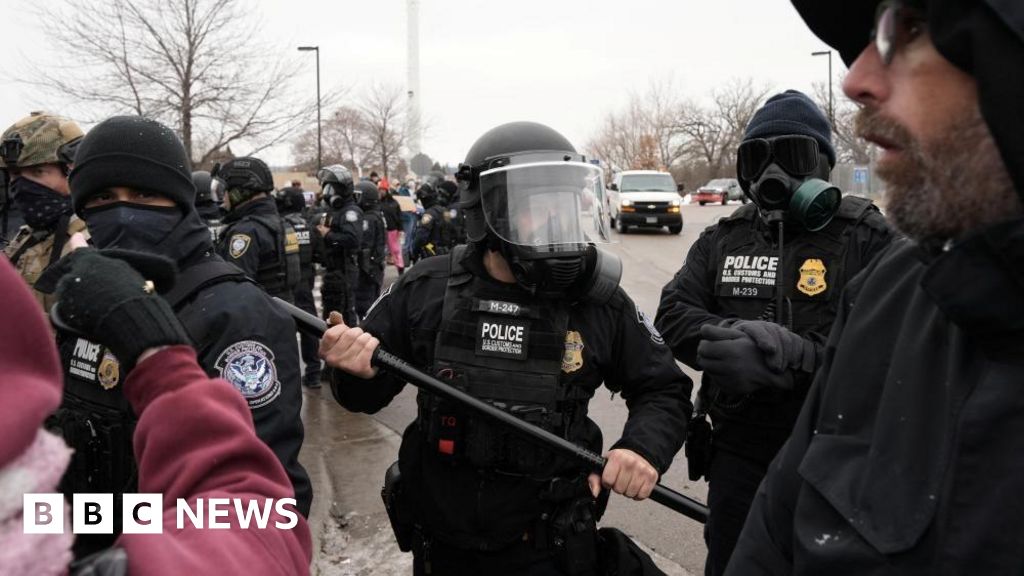
The US Justice Department is reportedly investigating Minnesota Governor Tim Walz and Minneapolis Mayor Jacob Frey under 18 U.S.C. § 372 for alleged attempts to impede ICE operations amid mass protests after an ICE agent fatally shot Renee Good. A federal judge restricted federal officers' use of non‑lethal force and arrests of peaceful protesters, halting certain enforcement actions even as thousands of ICE personnel remain deployed; the FBI is investigating the shooting. The developments increase local political and operational risk, introduce legal constraints on federal enforcement in Minneapolis, and heighten the potential for continued unrest and political blowback that could affect regional policy and public‑safety costs.
Market structure: The immediate beneficiaries are vendors of transparency and private security — chiefly Axon (AAXN) for body‑cams/cloud subscriptions and ADT (ADT) for private security services — as municipal pressure and calls for cameras increase procurement demand by an incremental 5–15% in affected cities over 6–12 months. Losers in the near–to–medium term are prison/detention operators (GEO, CXW) and localized tourism/retail exposure in Minneapolis; reputational and legislative risk can knock 15–40% off discretionary contract pipelines if federal or state funding is curtailed.
Risk assessment: Tail risks include a rapid increase in federal enforcement funding (positive for GEO/CXW and defense contractors) or federal troop deployment/Insurrection Act invocation (market shock; equity volatility spike >30% intraday). Immediate timeframe (days): headline-driven volatility; short-term (weeks–months): DOJ findings, local ordinances, DHS budget hearings; long-term (quarters): procurement cycles and contract renewals. Hidden dependencies: congressional DHS appropriations, municipal procurement budgets, and election outcomes that can flip policy and funding within 3–12 months.
Trade implications: Construct directional exposure to security tech and private security with size discipline: overweight AAXN and ADT (1–3% each) and underweight/short GEO and CXW (1–2% each), implementing option structures (3–6 month call spreads on AAXN; puts on GEO/CXW) to control downside. Cross‑asset: (1) modest long USD FX bullishness if unrest pressures perceived safe haven flows; (2) muni spreads for Minnesota could widen 10–25bps — hedge with national muni ETF (MUB) vs state munis.
Contrarian angles: Consensus may overvalue immediate upside to detention operators from active ICE deployments; second‑order political backlash, local procurement bans, and litigation could more than offset short-term revenue, so short convex exposure is attractive. Historical parallels (2020 protests) show body‑cam/cloud vendors saw durable subscription upside post‑policy change; therefore AAXN’s recurring revenue may be underpriced by 10–30% over 12 months. Monitor DOJ inquiry milestones (30–90 day windows) as binary catalysts.
AI-powered research, real-time alerts, and portfolio analytics for institutional investors.
Request DemoOverall Sentiment
moderately negative
Sentiment Score
-0.30
