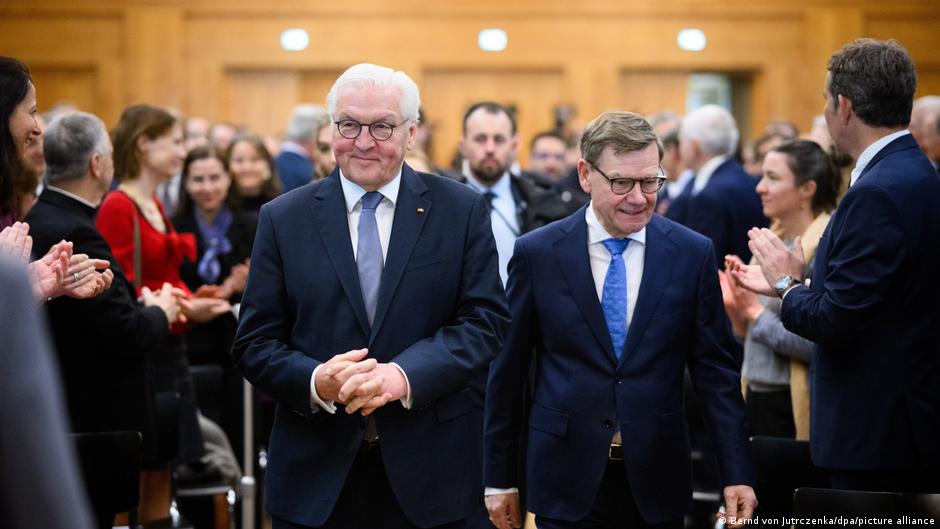
German President Frank-Walter Steinmeier and Foreign Minister Johann Wadephul publicly condemned US/Israeli attacks on Iran, with Steinmeier calling the war an "avoidable, unnecessary" breach of international law and Wadephul warning that transatlantic ties and European security face new epochal challenges. Their statements underscore heightened geopolitical risk — simultaneous conflicts on Europe’s borders and in the Middle East — likely to reinforce risk-off positioning and complicate coordinated diplomatic or economic responses across markets and allies.
Germany’s public distancing from the US over the Iran war materially raises political risk around the European security compact; expect EU policymakers to accelerate “strategic autonomy” actions that reallocate capital from civil imports to defense and dual-use manufacturing over 6–24 months. That reallocation is a multi-year earnings lever for European defense primes and their tier-1 supply chains (precision metals, guidance electronics, C4ISR) and should compress multiples on discretionary exporters whose access to US-led markets or sanctions waivers becomes more conditional.
In the near term (days–weeks) the market impulse is risk-off: safe-haven flows (USD, USTs) and higher war-risk premia in shipping/insurance can show up immediately, while oil/inflation effects play out over 1–3 months and push central-bank reaction risk higher. An oil shock above a material threshold (~$80–90/bbl depending on current market) would be the clearest catalyst to flip the macro regime from stagflation optimism to persistent hawkish policy and higher real yields, which in turn would hurt long-duration tech and European financials.
Second-order supply-chain effects favor onshore capacity and inventory building: expect accelerated EU funding and procurement that benefits domestic machine-tool makers, semiconductor assembly for defense, and specialized metals refiners. Conversely, firms with material Iran/MENA revenue or those dependent on US diplomatic cover for trade (large German industrial exporters and certain banking counterparties) face idiosyncratic sanction/legal risk within 3–12 months.
The principal reversal path is diplomatic de-escalation or a convincing intelligence narrative that restores US domestic consensus, which would unwind risk premia rapidly (days–weeks). Electoral outcomes in the US or a coordinated EU-US crisis management framework are high-probability catalysts to compress the premium; absent that, structural re-rating of defense and insurance sectors looks more durable.
AI-powered research, real-time alerts, and portfolio analytics for institutional investors.
Request DemoOverall Sentiment
strongly negative
Sentiment Score
-0.60
