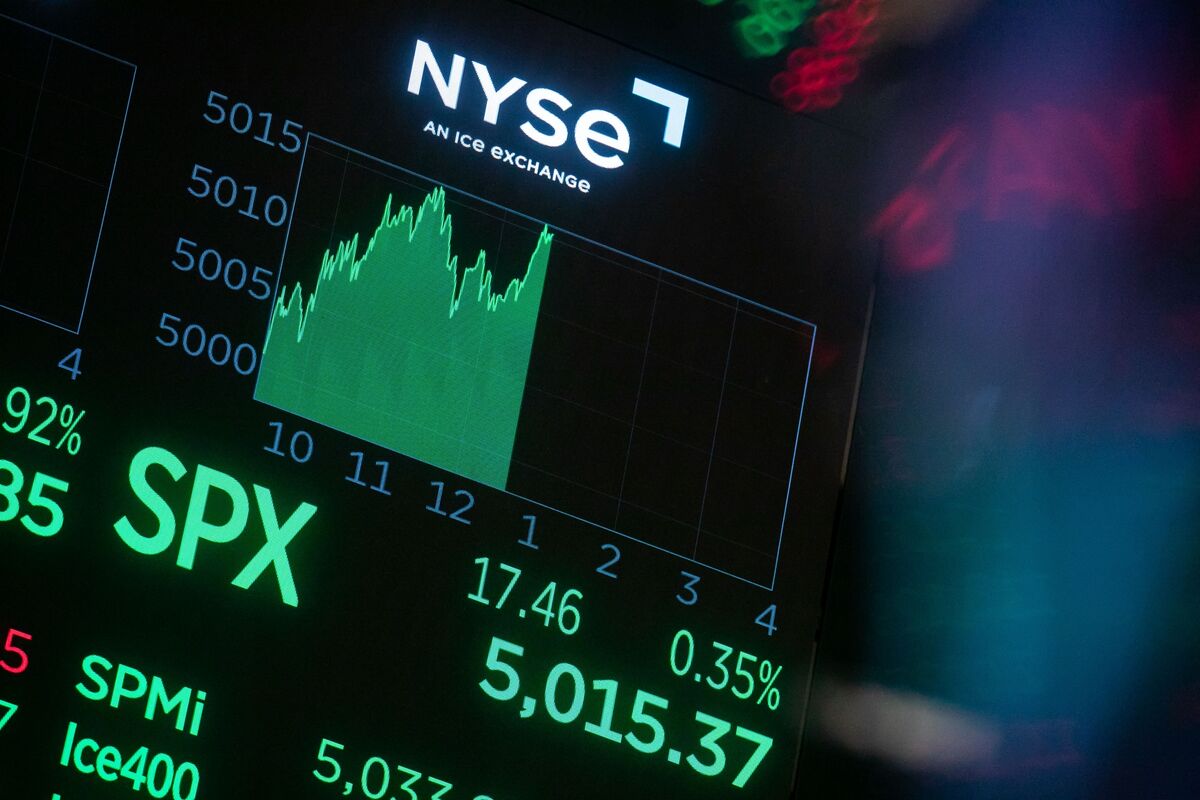
JPMorgan Chase’s Private Bank presents a bull case that could lift the S&P 500 roughly 20% by 2027 and expects the index to continue strong multiyear returns into 2026. US equities have rallied about 4% in the past four days, the S&P is up 16% year-to-date after consecutive prior-year gains of at least 23%, and the index was reported up 0.9% at 6,828 as of 11:41 a.m. in New York—moves that have quieted correction warnings and support a risk-on stance for investors.
Market structure: A JPMorgan private-bank bullish view supporting a ~+20% S&P by 2027 favors large-cap growth, semiconductors (SMH), and cyclical consumer discretionary (XLY) via flow-driven multiple expansion and continued buybacks reducing free float. Losers are long-duration bonds (TLT), gold and defensive staples/utilities (XLP/XLU) as equity risk appetite compresses equity risk premia by an estimated 50–100bp and could push 10y yields ~20–40bp lower in a risk-on squeeze. Cross-assets: expect USD softness versus EM FX on continued equity flows, higher oil if growth surprises, and lower realized equity vols short-term (~VIX 10–15) until a macro catalyst arrives.
Risk assessment: Tail risks include a Fed hiking surprise (terminal rate >5% or +25–50bp shock), a US recession that cuts EPS by >10% in 12 months, or a banking/regulatory shock that freezes buybacks; any of these could trigger >15% equity drawdowns. Time horizons: days—momentum; weeks/months—CPI, payrolls, earnings season; long-term (to 2027)—realized returns hinge on EPS CAGR ~5–8% plus modest multiple expansion. Hidden dependencies include buyback cadence, credit spreads and retail positioning; catalysts to reverse include two consecutive CPI prints >0.4% m/m or 10y >4%.
Trade implications: Tactical overweight equities via SPY/QQQ and SMH, underweight TLT and XLU/XLP; implement call-spread exposure to limit premium spent and pair trades to exploit rotation (long XLY, short XLP). Options: buy 3–6m 5% OTM QQQ call spreads sized 1–2% portfolio or sell 30-delta SPY puts for income sized 1% with a defined collar; maintain a 1–2% portfolio-long tail hedge (12% OTM puts 6–12m). Entry: add on <3% pullbacks or after 10-day SMA confirms momentum; trim if S&P breaches -7% from recent peak or 10y >4%.
Contrarian angles: Consensus underestimates earnings risk—if EPS growth falls below 3% p.a., the 20% price target implies unrealistic multiple expansion; history (2017–18) shows tech-led rallies can reverse quickly on Fed tightening. Reaction is partially overdone in crowding: look for crowded-gamma signals and elevated net-long positioning; unintended consequence of a bullish narrative is a sharper volatility spike on any macro hiccup, so size positions with explicit drawdown limits (5–8%).
AI-powered research, real-time alerts, and portfolio analytics for institutional investors.
Request DemoOverall Sentiment
moderately positive
Sentiment Score
0.45
Ticker Sentiment
