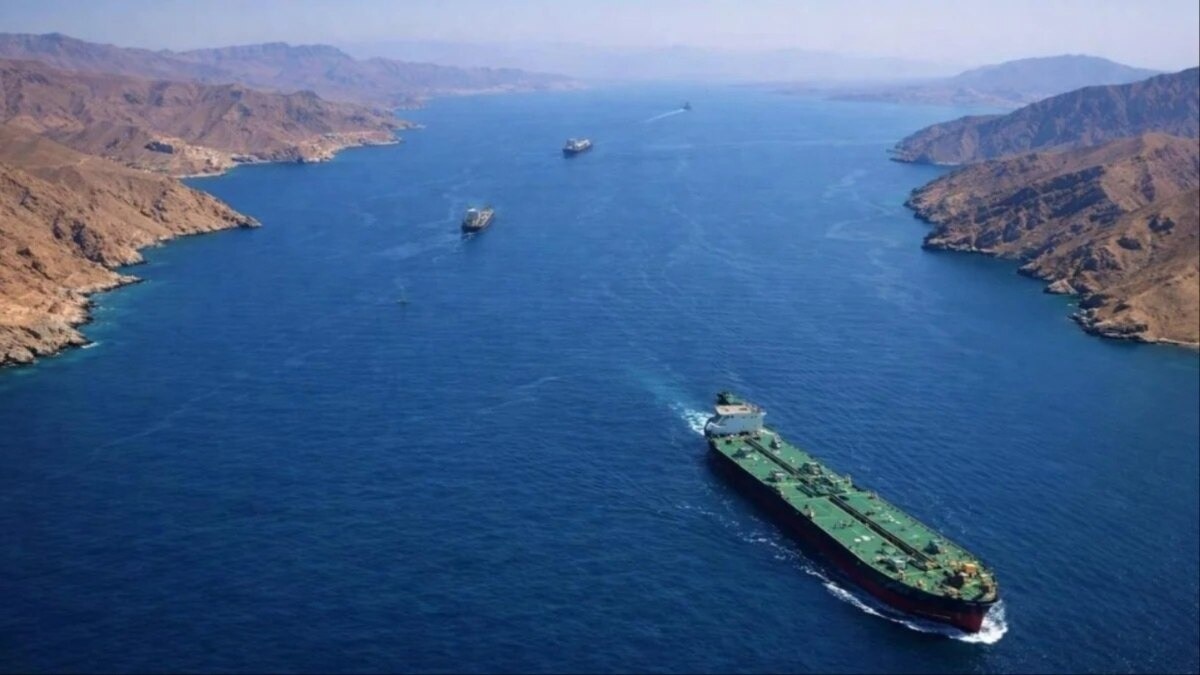
A two-week truce was agreed to temporarily reopen the Strait of Hormuz, which carries roughly 20% of global oil flows, but Iran warned of sea-mine threats and issued revised entry/exit corridors requiring ships to coordinate with the IRGC Navy. Iran directed vessels to use alternate routes around Larak Island and signalled potential long-term transit charges (tolls), a move reported as contested by Oman and under consideration by the US. The developments raise near-term disruption risk to oil/gas shipments and shipping lanes, implying upward pressure on energy prices and heightened volatility for transport and commodity-linked sectors.
A chokepoint risk priced into markets through higher insurance and longer voyages amplifies shipping cost elasticity more than headline supply loss. For VLCC/Suezmax voyages, an incremental 1–3 days of sailing or avoidance reroutes typically add $150k–$400k in bunker and time-charter-equivalent costs per voyage (roughly $0.05–$0.20/bbl on a 2m bbl cargo), which mechanically lifts spot freight rates by ~10–30% and forces refiners to either widen crude sourcing or eat margin compression.
If a durable fee-for-transit regime is institutionalized, the economics shift from transitory freight spreads to permanent delivered-cost inflation for Middle East barrels; a modest charge of $0.50–$1.50/bbl would be equivalent to a 0.5–1.5% immediate reduction in global spare capacity when measured by effective marginal cost. Near-term price sensitivity will be driven by visible tanker availability and insurance rate moves (days–weeks), while a fee regime or sustained interdiction becomes a multi-quarter to multi-year structural premium.
Catalysts to widen the shock include military escalation, expanded exclusion zones, or formalization of transit levies; reversals come from coordinated naval escort guarantees, emergency releases from SPR or quick rerouting throughput restoration. Monitor three high-leverage indicators: 1) spot VLCC and Suezmax time-charter indices, 2) ship-owner war-risk premiums, and 3) Brent backwardation — moves in these within 48–72 hours will pre-announce broader energy and freight repricing.
Consensus often overweights headline closure risk and underweights adaptive supply responses (alternate sourcing, short-cycle production increases, and strategic releases). That makes short-duration, convex trades (options on freight or oil) preferable to long-duration outright positions until fee permanency is proven over multiple quarters.
AI-powered research, real-time alerts, and portfolio analytics for institutional investors.
Request DemoOverall Sentiment
mildly negative
Sentiment Score
-0.25
