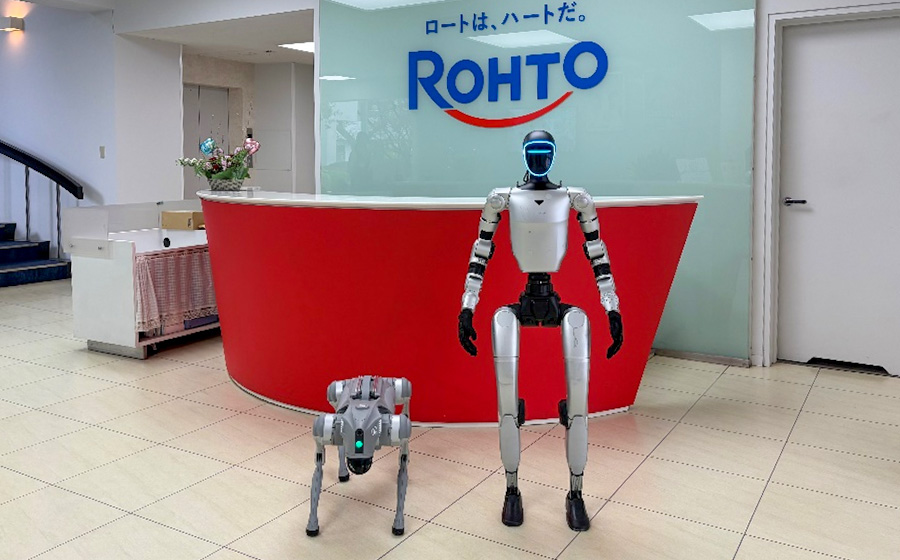
Rohto launched a "Humanoid Development Project" on March 31, 2026 to deploy physical AI and humanoid collaboration at its Ueno Techno Center, leveraging its existing CPS (Cyber-Physical Systems) infrastructure. The initiative targets operational tasks including automatic transport of lightweight objects, safety patrols/guidance, line-switch monitoring and packing, aiming to reduce workload, raise productivity and shift employees to higher-value work. No financial guidance, capex or quantified productivity gains were disclosed; demonstrations and safety/verifications will be conducted while partnering with external technology and experts.
A legacy consumer-health manufacturer that layers physical AI onto an existing CPS footprint creates asymmetrical demand for precision sensors, mobile manipulation modules, and low-latency edge compute — vendors that supply standardized, safety-certified humanoid subassemblies and verification tooling will capture outsized margins versus bespoke integrators. Expect a multi-year cadence: pilot-to-production conversions will drive durable capex in robotics (12–36 months) and recurring software/maintenance spend thereafter, turning one-time automation projects into annuity-like services for platform players.
Second-order supply-chain effects are underappreciated: certification, safety insurance, and human-interface training become bottlenecks that create new niche oligopolies (certifiers, insurers, training-as-a-service). Geopolitically, the first movers in Japan that document compliance and quality outcomes will export a regulatory playbook; conversely, fast-scaling Chinese rivals could undercut hardware prices, pressuring gross margins for domestic suppliers unless they monetize software/recurring services.
Key risks that can reverse momentum are operational safety incidents and conservative regulatory guidance — either can stall deployments for 6–18 months and impose retrofitting costs that push payback beyond acceptable thresholds. Near-term catalysts to monitor: published OEE/labor-hour improvement metrics from pilot sites, partnerships with recognized robotics OEMs, and national regulatory clarifications; these events should move equity cross-sections, not the broad sector, so position sizing matters.
AI-powered research, real-time alerts, and portfolio analytics for institutional investors.
Request DemoOverall Sentiment
mildly positive
Sentiment Score
0.25
