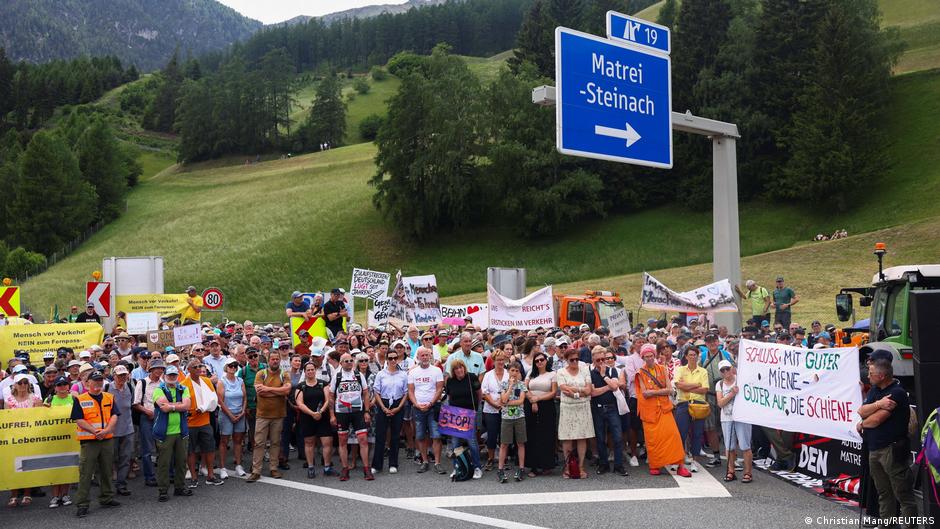
The article is a broad roundup of Germany-related news, led by the reopening of the Brenner Pass after a protest that turned back 219 trucks and briefly disrupted a key Alpine freight corridor. It also covers Germany-France nuclear deterrence talks, AfD migration policy proposals, climate protests over new gas plants, and Munich Airport briefly halting flights after a suspected drone sighting. Overall tone is factual and politically focused, with limited direct market implications beyond localized transport and infrastructure disruptions.
The biggest market read-through is not the protest itself, but the growing political willingness in Germany to treat logistics, energy, and security as interlinked strategic assets rather than purely efficiency-maximizing systems. That favors capital spending in rail freight, border infrastructure, airport security, and defense logistics over road-centric transport plays; the second-order beneficiary is anyone selling capacity buffering, surveillance, and dual-use mobility rather than just pure throughput. In practice, recurring disruptions at high-friction corridors like Brenner increase the option value of redundancy: more warehouses, more inland terminals, more rail headroom, and more localized inventory.
For energy, the signal is that Germany is still moving toward firm capacity even if it remains rhetorically climate-neutral. That is a subtle positive for developers and utilities with flexible gas generation or hydrogen-ready assets, because the policy debate is shifting from decarbonization purity to resilience pricing; the risk is that permitting and subsidy structure could still lag rhetoric by 12-24 months. On the flip side, the anti-gas protests tell you the political path is not linear, so the best trades are on companies with diversified buildouts rather than single-asset exposed names.
Defense is the cleaner medium-term theme. More German armor and NATO activity in the Baltics supports a multi-year procurement cycle for tracked vehicles, air defense, drones, and logistics support; the first-order spend is already underway, but the second-order effect is sustained utilization and spare-parts demand, which tends to be margin-accretive for primes and select subcontractors. Contrarian view: the headline noise around leadership speculation, migration, and symbolism is mostly irrelevant to earnings, but it does matter because it hardens the coalition’s incentive to over-deliver on security and order, which can extend the runway for defense and border-tech outlays.
AI-powered research, real-time alerts, and portfolio analytics for institutional investors.
Request TrialOverall Sentiment
neutral
Sentiment Score
-0.05
