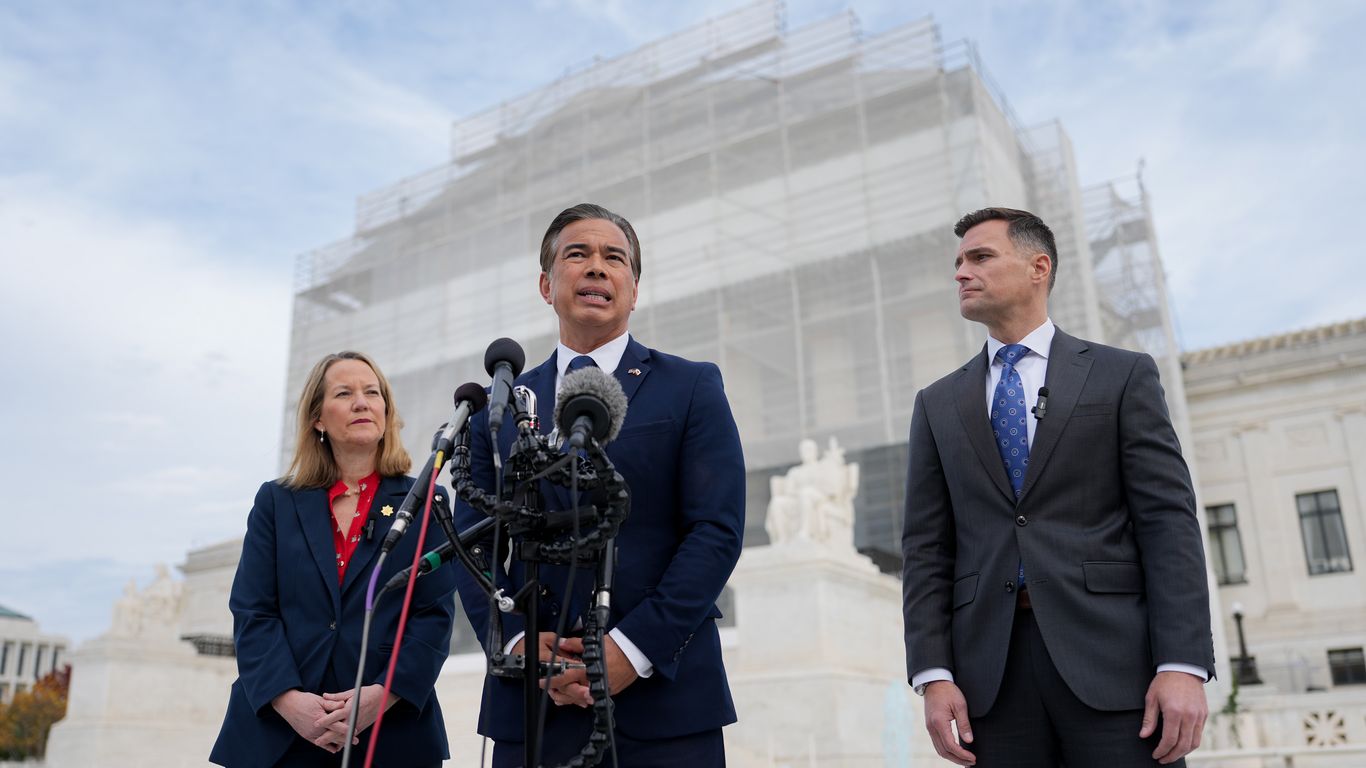
The Supreme Court justices appeared to question the scope of presidential authority to impose unilateral tariffs, specifically those enacted by former President Trump under the International Emergency Economic Powers Act (IEEPA), during Wednesday's oral arguments. While justices expressed skepticism regarding the executive branch's ability to bypass Congress for widespread tariffs, they also showed reluctance to entirely restrict emergency presidential powers, indicating a likely nuanced ruling that could establish specific guardrails rather than a binary outcome. This potential decision could significantly impact future presidential trade policy and presents considerable financial and logistical challenges, particularly concerning the potential refunding of tariff revenues if past tariffs are deemed unlawful.
The Supreme Court justices expressed significant skepticism regarding the scope of presidential authority to unilaterally impose tariffs under the International Emergency Economic Powers Act (IEEPA) during recent oral arguments. While questioning the executive branch's ability to bypass Congress for widespread tariffs, even conservative justices appeared hesitant to completely restrict emergency presidential powers. This suggests a likely nuanced ruling that could establish specific guardrails for future presidential tariff authority.
Legal experts anticipate the Court will complicate, but not entirely undermine, presidential economic agendas, potentially allowing tariffs only in certain instances. Justices Gorsuch and Jackson voiced concerns about the "serious retrieval problem" of granting broad tariff power and the validity of declared emergencies for tariffs, respectively. Conversely, Justice Kavanaugh highlighted the utility of such powers in geopolitical crises.
The Court's eventual decision carries a notable market impact, rated at 0.55, with an uncertain and mixed sentiment. A key risk highlighted is the logistical and financial complexity of refunding potentially unlawful tariff revenues, which Justice Barrett termed "a mess." Should tariffs be overturned, the process would likely involve remanding cases to lower courts to determine remedies, with the sum of contested tariff money accumulating during delays.
AI-powered research, real-time alerts, and portfolio analytics for institutional investors.
Request DemoOverall Sentiment
mixed
Sentiment Score
-0.05
