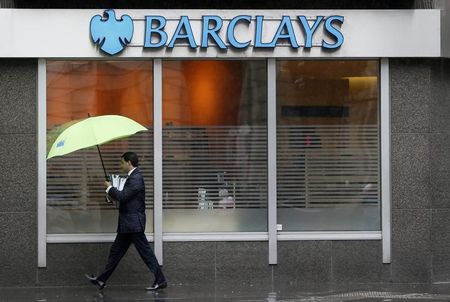
Jefferies kept buy ratings across UK domestic banks and lifted medium-term EPS forecasts by about 5%, while still seeing structural hedge income as a key tailwind. Barclays had its target raised to 590p, though targets were trimmed for NatWest to 730p, OneSavings Bank to 700p, and Paragon to 1,000p; Lloyds stayed at 125p. The broker flagged stronger credit growth, 16% Q1 2026 sector ROTE, and expected buybacks of roughly £2 billion each at Barclays and Lloyds, but warned that political risk and a possible bank surcharge increase could offset some upside.
The key mispricing is that this is no longer a pure rates trade; it is a convexity trade on political risk versus balance-sheet duration. The structural hedge still dominates near-term earnings power, but the market is discounting a policy regime shift before it discounts the duration benefit, which creates a window where the sector can look cheap on earnings while remaining technically de-rated. That mismatch usually resolves either through a sharp rerating once political noise fades or through an abrupt multiple compression if a credible surcharge/higher-tax path gets priced in.
Second-order winners are the most domestically leveraged franchises with the cleanest buyback capacity, because capital returns become the main transmission mechanism for the hedge tailwind. Barclays stands out because it couples a near-term earnings reacceleration with the fastest capital-return feedback loop; Lloyds is the cleaner medium-term expression if the market starts to trust that retail deposit beta and mortgage volume can compound through policy noise. NatWest looks more vulnerable to relative underperformance because its path to rerating is more dependent on sentiment normalization than on a unique earnings catalyst.
The bigger hidden risk is not credit deterioration; it is policy response lagging the earnings cycle. If tax/surcharge headlines intensify, the market can easily offset several quarters of profit upside by forcing higher discount rates on the whole sector. That means the next leg is likely driven less by operating data and more by polling, cabinet leadership probabilities, and fiscal commentary over the next 1-2 quarters.
Consensus is likely underestimating how much of the upside is already in the forward earnings model but not in the multiple. If the political overhang stabilizes, the sector does not need earnings beats to work; it only needs no further de-rating to unlock substantial revaluation. In that sense, the trade is more about timing entry around sentiment inflection than chasing near-term fundamentals.
AI-powered research, real-time alerts, and portfolio analytics for institutional investors.
Request DemoOverall Sentiment
mildly positive
Sentiment Score
0.25
Ticker Sentiment
