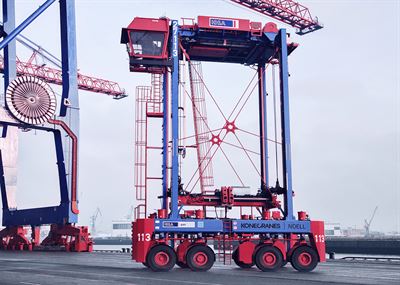
HHLA Container Terminal Tollerort GmbH has ordered eight hybrid Konecranes Noell NSC 644 EHY Straddle Carriers, an order booked in Q4 2025 with units expected in service by end-2026; the machines replace older diesel models and combine a diesel generator with onboard batteries to cut fuel use and tailpipe emissions. The carriers are built on Konecranes' new modular drive platform that can be upgraded to full battery-electric or hydrogen in future, reinforcing Konecranes' Ecolifting decarbonization roadmap and deepening the firms' Port of Hamburg partnership; the order is strategically positive for Konecranes' product positioning though likely immaterial to near-term group revenues (2024 sales EUR 4.2bn).
Market structure: Konecranes (KCR) is the direct beneficiary — order reinforces aftermarket, service and upgrade revenue streams and raises switching costs via a modular drive platform; marginal near-term revenue is small (8 units ≈ EUR 12–25m) but signals a broader fleet-replacement cycle in EU ports that could represent high-margin retrofit TAM over 3–7 years. Diesel-focused OEMs and fuel suppliers face gradual demand erosion in port handling segments as terminals accelerate emissions targets and prefer hybrid/EV-capable platforms.
Risk assessment: Tail risks include battery/drive reliability issues triggering warranty costs, or a rapid policy shift (subsidies for full-electric/hydrogen only) that makes hybrid genset solutions obsolete — both could swing margins ±5–15% for KCR over 12–36 months. Short-term (0–12 months) impact on KCR equity is likely muted; medium-term (12–36 months) is driven by retrofit/order cadence and infrastructure rollout; hidden dependency: port-side grid/hydrogen availability and HHLA capex cycles.
Trade implications: Favor equities that can capture OEM aftermarket optionality and modular upgrades (KCR) and battery-metal exposure (lithium/nickel) while underweight pure-diesel engine makers (CMI) and fuel suppliers. Use structure: concentrated equity exposure (2–3% position in KCR) plus a financed call spread to leverage catalytic upgrades around FY2026 deliveries; expect 12-month upside if KCR converts modular demand to service revenue.
Contrarian angles: Consensus may dismiss small order size — misses optionality: modular platforms can convert one-off sales into multi-year upgrade/service annuities (2–4x equipment revenue). Risk that customers delay purchases until full-battery/hydrogen availability could compress near-term sales; conversely, rapid retrofit demand would be underpriced by markets today.
AI-powered research, real-time alerts, and portfolio analytics for institutional investors.
Request DemoOverall Sentiment
mildly positive
Sentiment Score
0.25
