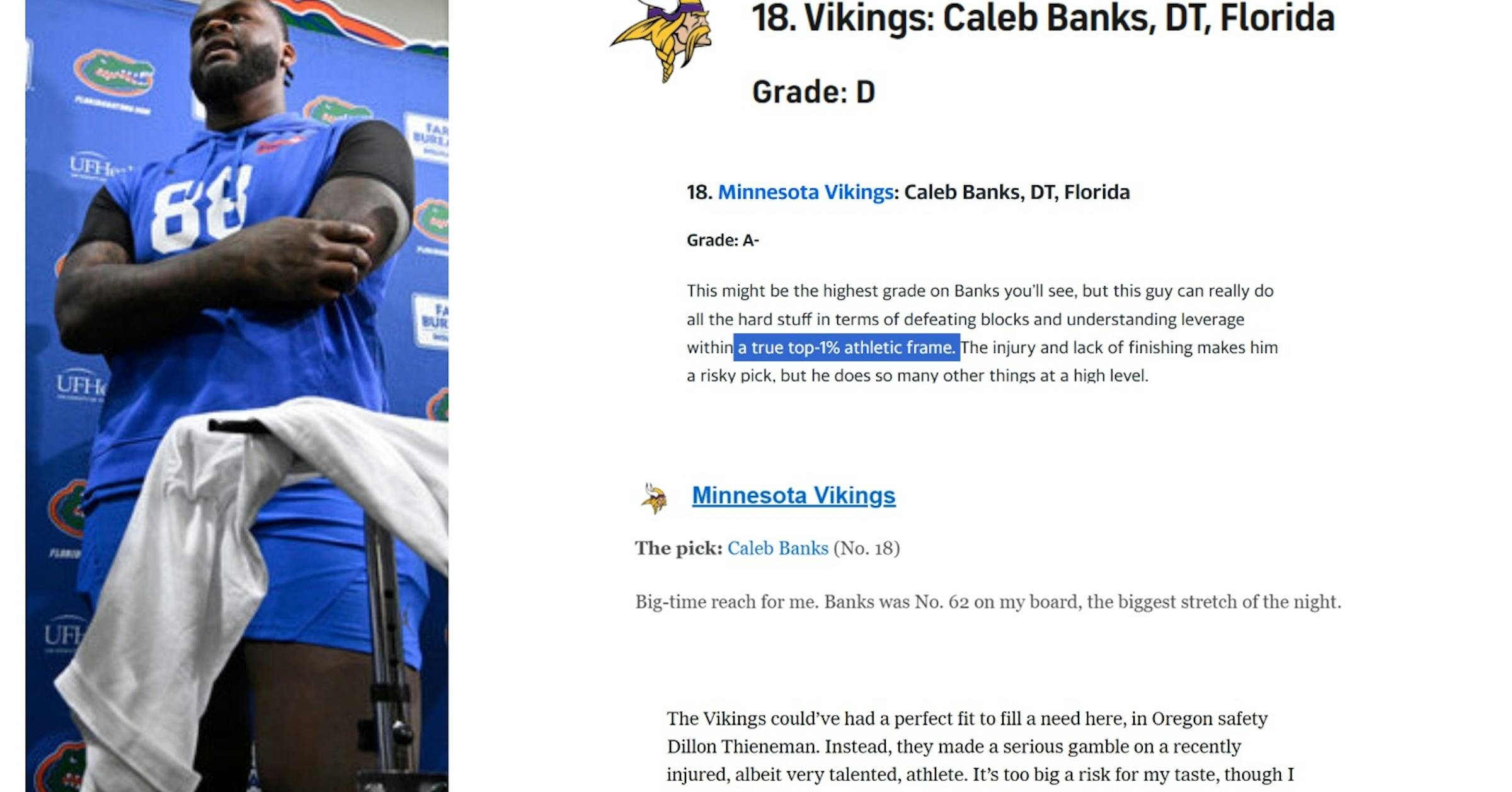
The article analyzes the Minnesota Vikings’ No. 18 overall draft pick, Caleb Banks, emphasizing his elite physical traits, positional fit, and injury risk rather than any immediate financial or market-moving development. The piece is largely opinion and post-draft commentary, with mixed reactions focused on whether he was the right player and whether No. 18 was the right draft slot. Market impact is minimal, as this is sports-analysis content rather than investment-relevant news.
The market takeaway is not about the player; it is about the Vikings signaling a willingness to pay a premium for scarcity at a position where replacement value is structurally poor. Interior disruptors are one of the few defensive assets that can independently swing win probability on early downs, and teams that lack them tend to leak value in adjacent areas: linebackers play heavier, safeties play deeper, and the pass rush becomes coverage-dependent. That creates a compounding effect over a multi-year horizon, which is why premium picks at this position often look expensive on draft night but can be efficient if the player clears his medical and developmental hurdles.
The key risk is not “draft bust” in the generic sense; it is concentration risk from athletic profiles that depend on lower-body durability. For a 330-pound interior lineman, foot/ankle fragility can compress the usable prime to 3-4 seasons rather than the 5-6 years teams typically model, and that matters because the value curve is front-loaded: year 1-2 availability determines whether the pick is a force multiplier or merely a rotational body. In other words, the downside is not just missed games — it is that the team may have paid for a premium run defender but still need to spend again if the player cannot hold up to 60%+ snap exposure.
The more interesting second-order effect is on market behavior around the draft room itself: this type of pick often reflects a front office choosing its own board over consensus, which can be a positive signal if repeated, but a negative one if it indicates overweighting traits while underweighting medical volatility. If the player hits, the Vikings’ defensive identity can shift quickly enough to change in-season opponent game plans within months; if he misses time early, the club is forced back into stopgap veteran solutions, which are usually negative EV and cap-inefficient. The mispricing opportunity is that the headline debate will focus on draft-slot value, while the real variable is availability-adjusted impact over the next 24 months.
AI-powered research, real-time alerts, and portfolio analytics for institutional investors.
Request TrialOverall Sentiment
neutral
Sentiment Score
0.05
