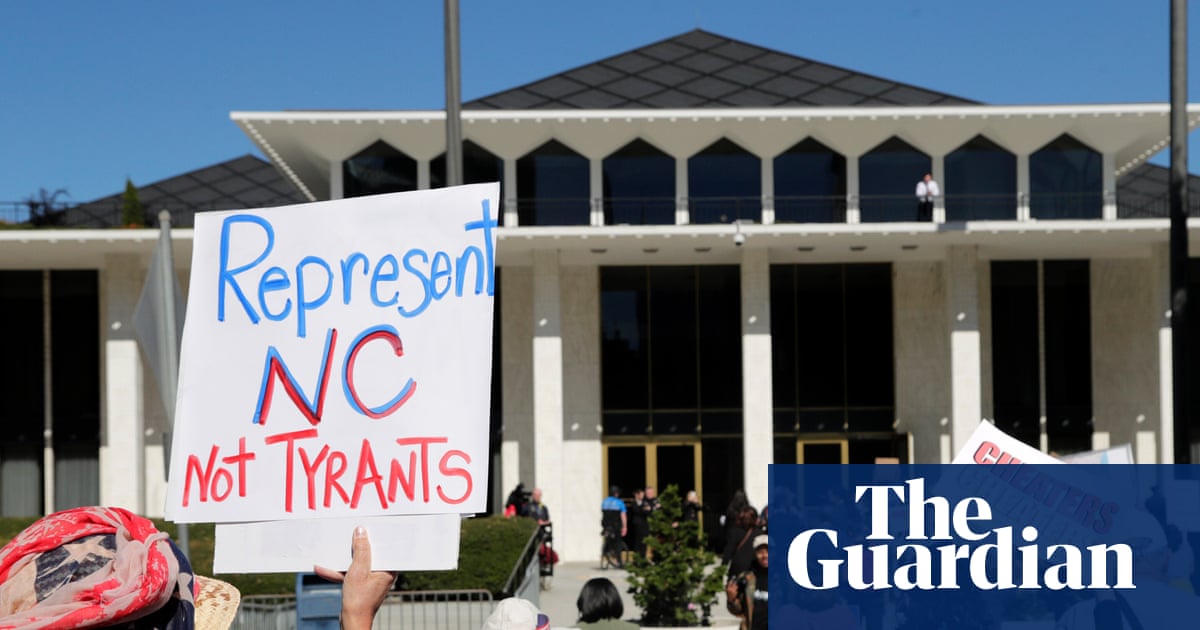
A three-judge federal panel allowed North Carolina to use a mid-decade redrawn congressional map designed to flip the state's only swing seat (the 1st District held by Democrat Don Davis) to Republicans, denying requests for preliminary injunctions. The decision, part of a broader Republican effort to redraw maps in several states ahead of 2026, could help preserve a slim GOP majority in the U.S. House; plaintiffs including the state NAACP and voters argue the map targeted Black communities and relied on five-year-old census data in violation of the First and Fourteenth Amendments. Candidate filing for 2026 races begins Dec. 1, and the ruling follows similar contested redraws in other states that have been temporarily restored by the U.S. Supreme Court.
Market structure: The immediate winner is the Republican midterm strategy—if maps hold it raises the GOP’s probability of retaining a slim House majority (removes ~3-seat pickup pathway Democrats needed), which favors defense contractors (ITA constituents like LMT, NOC), large integrated energy (XOM, CVX) and regional media (NXST) who benefit from higher ad and defense spending. Losers: pure-play renewables and solar installers (TAN, ENPH) and policy-sensitive healthcare reform beneficiaries if the House blocks Democratic initiatives; effects concentrate regionally in NC and similar swing states ahead of 2026.
Risk assessment: Key tail risks are legal reversals (court overturns mid-decade maps) or a contested 2026 outcome that could flip >3 seats; assign a 20–40% litigation reversal probability over 12–18 months. Short-term (days/weeks) market moves should be muted; medium-term (3–12 months) pricing will react to campaign ad buys and fiscal-signaling; long-term (2026 election outcome) drives structural sector rotations and yields/deficit expectations.
Trade implications: Favor 6–12 month exposure to defense (ITA) and integrated energy (XOM) via limited-risk call spreads (target +15–30% upside) and underweight solar ETFs (TAN) via put spreads. Use pair trades: long XOM (2–3% portfolio) / short ENPH (1–2%) or long ITA / short TAN to capture policy divergence. Protect with 3–6 month VIX calls or S&P put spreads sized 0.5–1% of portfolio if litigation escalates.
Contrarian angles: Consensus underestimates legal reversal probability and voter backlash — a struck-down map months before 2026 would spike volatility and reprice sector bets. Historical precedent (post-2010 mid-decade tactics) shows maps can be undone; be ready to trim cyclical longs by 50% on a Supreme Court or appellate reversal within 6–12 months, and look for local-media names to briefly outperform during heavy ad-buy windows.
AI-powered research, real-time alerts, and portfolio analytics for institutional investors.
Request DemoOverall Sentiment
neutral
Sentiment Score
0.00
