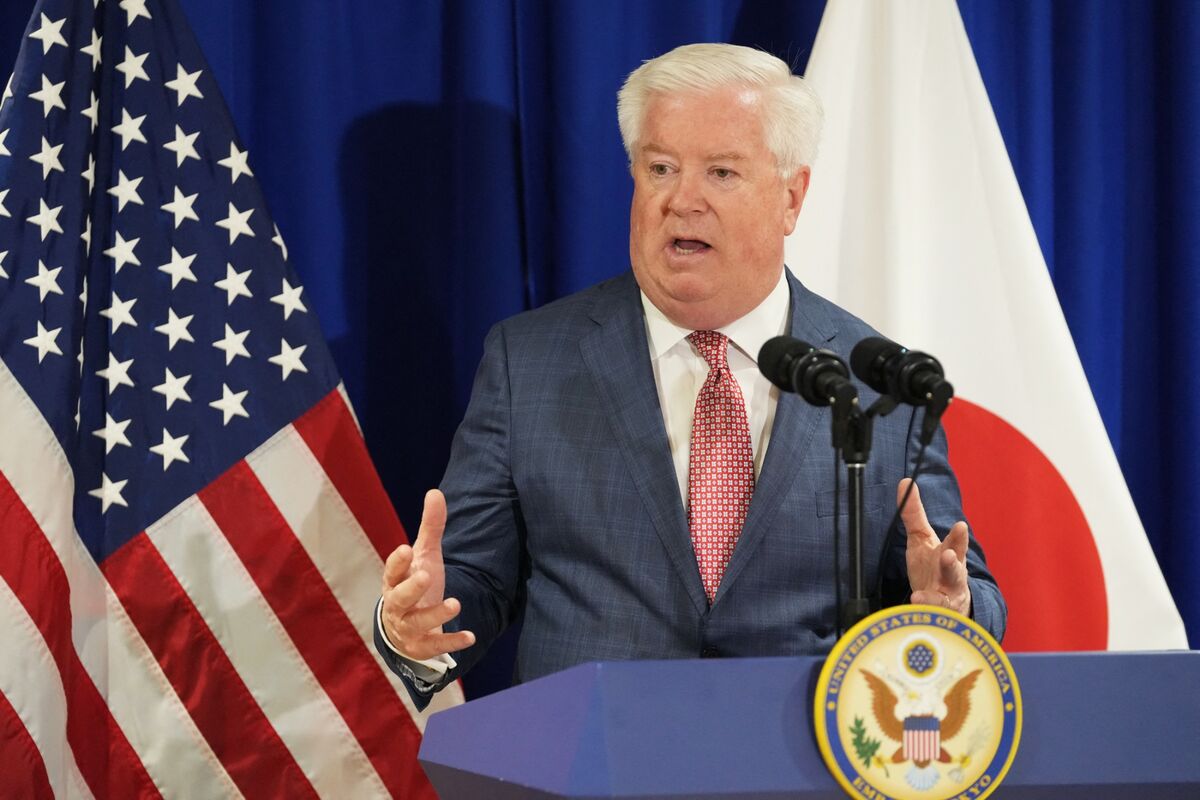
U.S. Ambassador to Japan George Glass said Washington unequivocally backs Prime Minister Sanae Takaichi in her dispute with Beijing over her comments on Taiwan, calling some of China’s responses “outrageous” and characterizing them as “a classic case of Chinese economic coercion.” Speaking after a meeting with Japanese Foreign Minister Toshimitsu Motegi, Glass said the support comes directly from the president, the embassy and himself, a stance that underscores firm U.S.-Japan diplomatic unity and highlights the risk of Chinese economic pressure that could exacerbate regional geopolitical and trade tensions.
U.S. Ambassador to Japan George Glass publicly declared that Washington "has her back" for Prime Minister Sanae Takaichi in her dispute with Beijing over comments on Taiwan, calling some of China's reactions "outrageous" and describing them as "a classic case of Chinese economic coercion." He framed the support as coming "directly from the president and from myself and from the embassy" after meeting with Japanese Foreign Minister Toshimitsu Motegi, signalling explicit high-level U.S. endorsement of Japan's position.
The article's theme classification (Geopolitics & War; Trade Policy & Supply Chain; Sanctions & Export Controls) and a hawkish tone point to elevated political risk around bilateral trade and supply chains. Market signals show a mildly negative sentiment score (-0.3) and a modest market impact score (0.35), implying potential for selective volatility rather than broad market dislocation absent concrete Chinese measures.
The immediate investment implication is an increased risk premium for firms with direct China exposure or tightly integrated regional supply chains, and a higher probability of targeted policy responses such as economic coercion or export controls. Investors should therefore monitor for concrete Chinese trade actions or sanctions language, as those would materially change sector-level risk and necessitate active rebalancing or hedging.
AI-powered research, real-time alerts, and portfolio analytics for institutional investors.
Request DemoOverall Sentiment
mildly negative
Sentiment Score
-0.30
