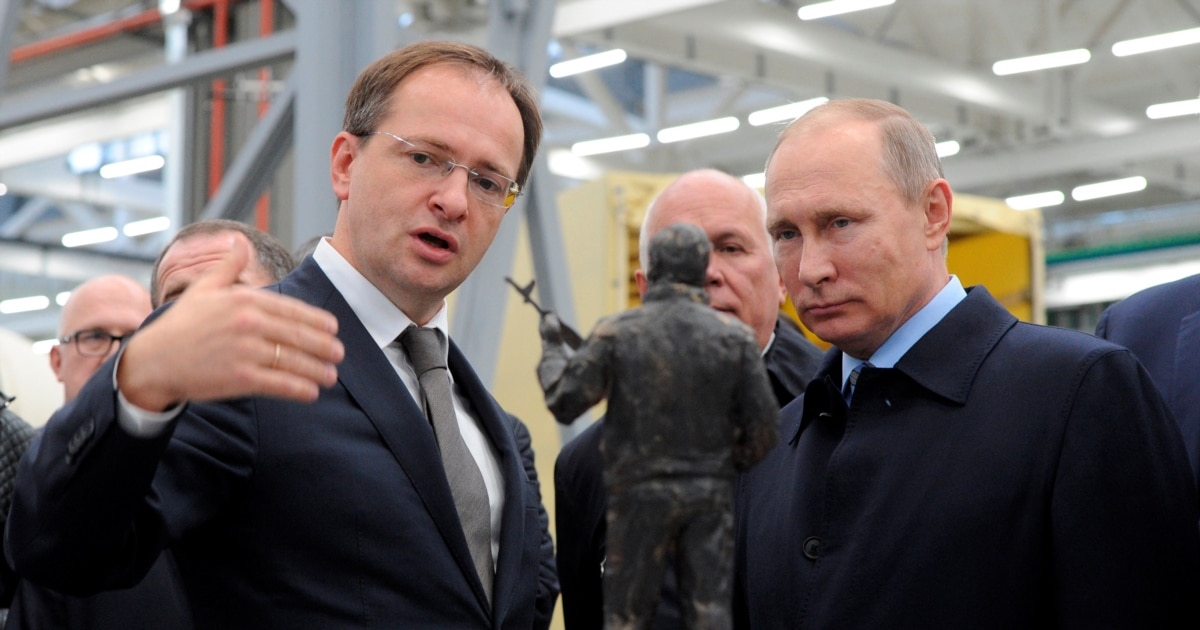
Geneva talks between Ukrainian and Russian delegations concluded without breakthrough, with Ukraine's president disparaging the negotiations and Russia represented by controversial historian Vladimir Medinsky, who is seen as promoting political and historical demands rather than negotiable compromises. Medinsky's return signals Moscow is reintroducing political conditions that Kyiv finds unacceptable, raising the prospect of stalled diplomacy and continued geopolitical risk that investors should monitor for implications to regional stability, sanctions policy and energy/defense-related sectors.
Market structure: A continuation of low-probability cease‑fire signaling (Medinsky’s role) implies a sustained idiosyncratic risk premium for defense, energy exporters and safe havens. Expect near-term (days–weeks) 5–15% spikes in Brent/TTF on flare‑ups and 1–3% EUR weakness vs USD as risk‑off flows to USD, gold and USTs; streaming/media (NFLX) has only marginal direct exposure to Russia but reputational noise can press multiples temporarily. Supply/demand: European gas re‑routing and LNG demand keep structural tightening for 6–18 months unless a diplomatic breakthrough or large Chinese demand drop occurs.
Risk assessment: Tail risks include full military escalation, expanded sanctions on third‑party energy firms, and cyber shocks to infrastructure — each <10% probability but market‑moving. Immediate horizon (days) sees volatility spikes in oil/gas and defense equities; weeks–months see capital spending reallocation (defense procurement), and 1–3 years could see a 5–20% uplift in EU defense budgets. Hidden dependencies: winter storage, Chinese diplomatic posture, and US political calendar; catalysts include new sanctions, battlefield shifts, or U.S./EU policy announcements.
Trade implications: Direct plays favor US defense primes (LMT, RTX, GD) and energy majors (XOM, CVX), plus GLD and TLT as risk hedges; consider short airline/leisure exposure (AAL, LUV) into earnings. Use options to buy 6–12 month call spreads on defense names to cap cost and 1–3 month put spreads on airlines or on NFLX if IV rises >30%. Entry window: act within 1–4 weeks for equities, immediate (48–72h) for GLD/TLT on any volatility spike.
Contrarian angles: Consensus may overprice permanent high oil — if China eases demand or a diplomatic detente occurs, energy could retrace 10–25% within 3–6 months. NFLX downside from this article is likely overdone: Russia is a small revenue point — a disciplined buy-on-pullback below an 8–12% drop could be rewarded. Historical parallel: post‑2014 Crimea saw defense stocks outperform by 30–50% over two years; a similar multi‑quarter reallocation is plausible here.
AI-powered research, real-time alerts, and portfolio analytics for institutional investors.
Request DemoOverall Sentiment
mildly negative
Sentiment Score
-0.30
Ticker Sentiment
