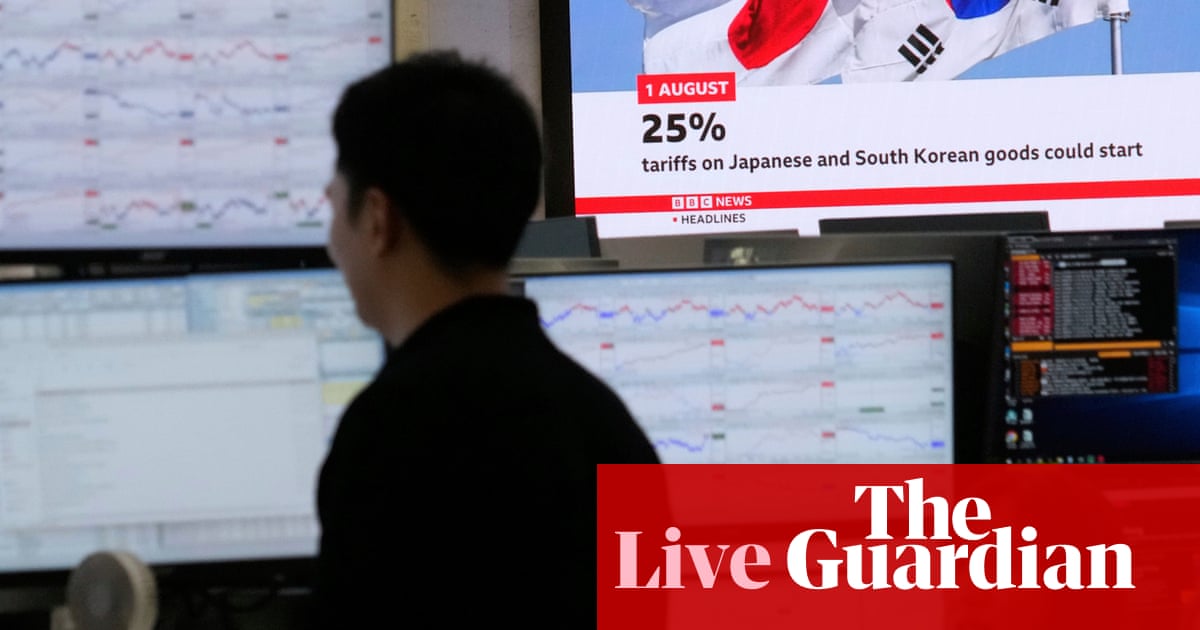
Donald Trump announced new tariffs on 14 trading partners, but a crucial three-week reprieve until August 1st prompted Asia-Pacific markets to largely shrug off the threats, with the Nikkei and KOSPI rising. This market reaction is attributed to investor expectations of further negotiation and de-escalation, a pattern dubbed 'TACO' (Trump Always Chickens Out). While affected nations like the EU, Japan, and Malaysia are engaging in talks for concessions, analysts caution that the delay prolongs uncertainty, as evidenced by a sharp decline in German exports to the US as previous trade 'frontloading' dissipated, underscoring persistent volatility in global trade policy.
Global equity markets are exhibiting a bifurcated response to the latest developments in U.S. trade policy. While Wall Street reacted negatively, Asia-Pacific markets, including Japan's Nikkei 225 (+0.3%) and South Korea's KOSPI (+2.0%), largely dismissed the announcement of new tariffs on 14 trading partners. This resilience stems from a three-week reprieve, pushing the implementation deadline to August 1, which investors are interpreting as a familiar 'escalate to de-escalate' tactic, or 'TACO' (Trump Always Chickens Out). However, this market sentiment contrasts with warnings from analysts who view the delay as an extension of uncertainty rather than a positive development. The real economic impact is already evident in recent data, with German exports to the U.S. falling 7.7% month-over-month in May as the effects of prior tariff frontloading unwound. Meanwhile, affected blocs and nations, including the EU, Japan, and Malaysia, are actively pursuing negotiations for concessions, with the EU specifically focused on mitigating the impact on its auto sector. The situation is further complicated by China's explicit warning against reigniting trade tensions and its threat of retaliation on supply chain deals, underscoring the persistent volatility and unresolved nature of the global trade landscape.
AI-powered research, real-time alerts, and portfolio analytics for institutional investors.
Overall Sentiment
mixed
Sentiment Score
0.15
Ticker Sentiment
