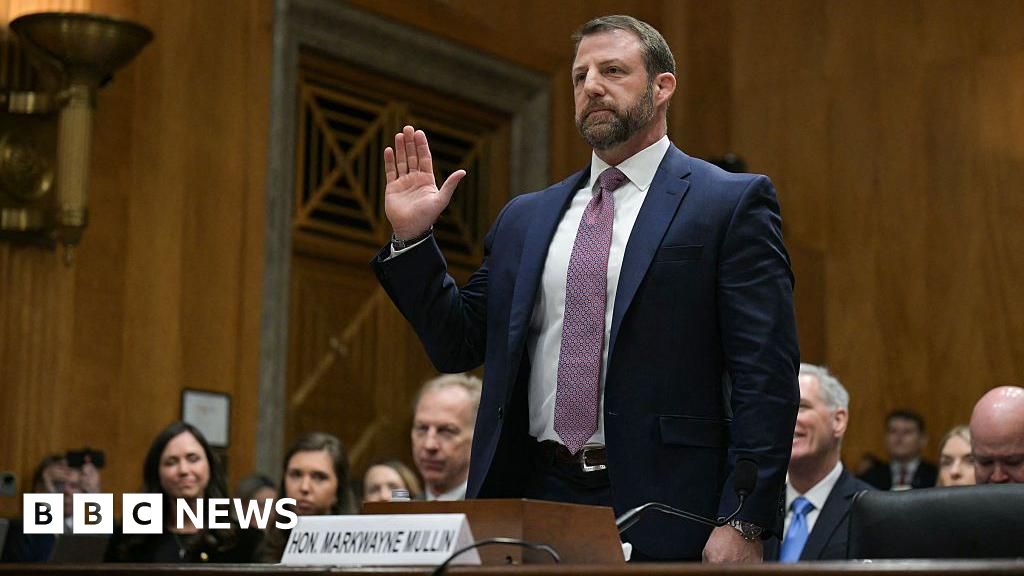
54-45 Senate vote confirmed Senator Markwayne Mullin as Secretary of Homeland Security. He will assume control of immigration enforcement, border protection and airport security amid a partial government shutdown and DHS funding impasse, replacing Kristi Noem after just over a year in the role. Mullin, a staunch Trump ally, promises tougher immigration enforcement and said ICE will generally use judicial warrants unless agents are in active pursuit; his confirmation drew bipartisan criticism and one Republican (Sen. Rand Paul) opposed the nomination.
The confirmation crystallizes policy direction even as appropriations remain unsettled: expect an initial flurry of contract re-scoping toward hardened border technology, analytics and mission-support services rather than large civil works that require multi-year appropriations. That favors prime contractors with flexible ID/IQ vehicles and software-upgrade revenue (higher margin, faster delivery) over heavy construction firms which need FY-level line items and long bid cycles.
Near-term liquidity and political optics are the dominant risks — a continued funding impasse compresses award timing for new programs for 30–90 days, while legal and NGO pushback can delay deployments by quarters; thus revenue upside is likely to be back-loaded into the FY+1 cycle rather than immediate. Over a 6–18 month horizon, surveillance, analytics and cloud/cybersecurity vendors that already have integration contracts will capture the fastest incremental spend, creating a two-tier winners/losers dynamic.
Second-order effects: accelerated border enforcement increases demand for managed services (transportation, detention logistics, document processing), which benefits niche services and subcontractors along regional supply chains but raises reputational and counterparty risk for primes that rely on municipal or international partners. Institutional players should price in a >30% chance of episodic headline-driven volatility tied to litigation or appropriation showdowns in the next 6 months, which can flip perceived winners into short-term losers despite favorable policy tilt.
AI-powered research, real-time alerts, and portfolio analytics for institutional investors.
Overall Sentiment
mixed
Sentiment Score
-0.05
