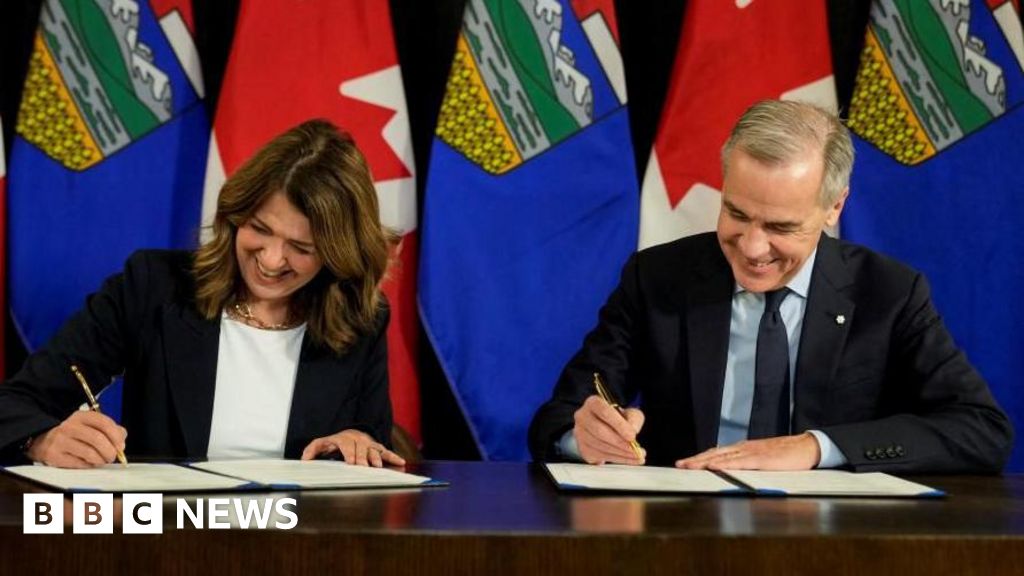
Prime Minister Mark Carney and Alberta have signed an agreement that clears the way for a proposed Alberta-to-Pacific oil pipeline by exempting it from a BC tanker ban and suspending a federal oil & gas emissions cap, while requiring higher provincial carbon pricing, indigenous co-ownership and a large carbon-capture programme. The deal includes a C$14m Alberta pledge to develop a private-sector-ready proposal but has no private backer or firm route, faces strong opposition from BC and indigenous groups, and prompted the resignation of a cabinet minister, leaving significant political, regulatory and financing hurdles before the project could affect oil export flows to Asia.
Market structure: The memorandum asymmetrically benefits Alberta heavy-oil producers and fee-based midstream developers (Canadian Natural CNQ, Cenovus CVE, Suncor SU; ENB, TRP) by opening optionality to tidewater and Asian crude markets. If realized, WCS-to-WTI differentials could compress by an estimated $5–15/bbl over multi-year buildout, boosting upstream free cash flow 10–30% vs current baselines; near-term supply is unchanged so price moves will be driven by risk-premia and FX. Cross-asset: CAD could strengthen 1–3% on a material financing/BC buy-in; provincial bond spreads and energy credit spreads would tighten as export-risk falls.
Risk assessment: Tail risks are dominated by Indigenous and BC legal/ political vetoes, private financing failure, and CCUS cost overruns—each can kill the project and cause >30% re-rating in exposed equities. Time horizons: immediate (days–weeks) = headline-driven volatility; short-term (3–12 months) = financing/BC engagement and MoU milestones; long-term (3–7 years) = construction/commercial flows. Hidden dependency: Indigenous co-ownership requirement and private capital condition mean provincial political support alone does not de-risk execution.
Trade implications: Tactical positions should be asymmetric and event-driven: small, scalable longs in CNQ/CVE and ENB/TRP to capture upside if financing/BC buy-in occur; use options to limit downside. Pair trades: long Canadian heavy producers vs short large-cap integrated US oil (e.g., XOM) to isolate Canadian export optionality. Entry triggers: scale in on (A) signed private financing or (B) BC formally joining talks; stop-loss/exit on injunctions or financing withdrawal within 90 days.
Contrarian angles: Consensus treats the MoU as de-risking but historical parallels (Keystone XL, Northern Gateway) show multi-year political defeat is likelier than quick delivery; market may be overstating near-term win. Unintended consequence: the CCUS/price hike requirements could materially raise project breakevens, creating stranded-asset risk; this favours fee-based midstream exposure over upstream owning long-lived heavy-oil inventory.
AI-powered research, real-time alerts, and portfolio analytics for institutional investors.
Request DemoOverall Sentiment
mixed
Sentiment Score
-0.05
