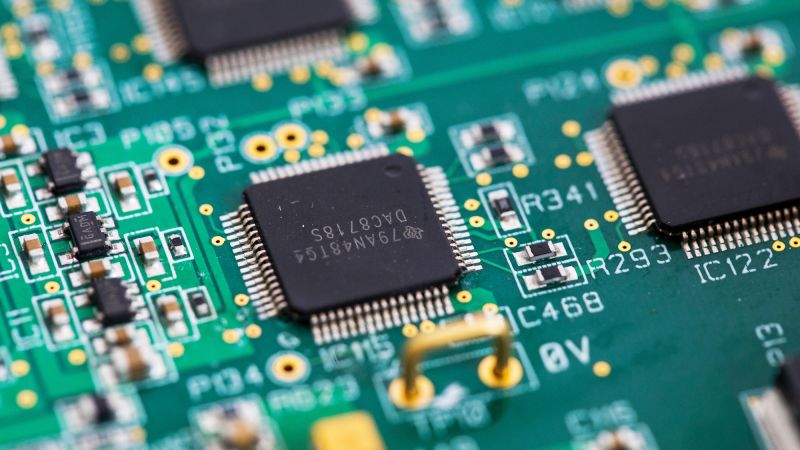
Texas Instruments announced a $60 billion investment to expand U.S. semiconductor manufacturing across Texas and Utah, creating over 60,000 jobs, as part of the Trump administration's push to bolster domestic chip production and compete with China in the technology sector. The move, touted as the largest investment in foundational semiconductor manufacturing in U.S. history, aligns with similar onshoring efforts from companies like General Motors and Apple amid government pressure and incentives. While the initiative aims to revive U.S. manufacturing, challenges remain regarding labor skills and component availability for producing complex electronics domestically.
Texas Instruments (TXN) has announced a substantial $60 billion investment to expand semiconductor manufacturing in the United States across Texas and Utah, a move projected to generate over 60,000 jobs. The company characterizes this as the "largest investment in foundational semiconductor manufacturing in US history," aligning with the Trump administration's stated priority to increase domestic chip production, bolster US technological competitiveness against China, and promote American manufacturing, a sentiment echoed by US Commerce Secretary Howard Lutnick. This initiative is part of a wider trend of onshoring, exemplified by General Motors' (GM) $4 billion investment in US production, Apple's (AAPL) $500 billion commitment to expand US facilities, and a collaboration between Oracle (ORCL), OpenAI, and SoftBank to develop AI infrastructure in America. While some companies like Apple and TSMC had initiated US expansions prior to the current administration's second term, the political environment, including tariff measures and a focus on reviving US manufacturing—as seen with the planned US-built Trump Mobile smartphone—amplifies this trend. However, experts caution that domestic manufacturing of complex electronics faces significant challenges, notably the lack of requisite labor skills and component availability. The strategic imperative to maintain a technological edge, particularly in AI following advancements by Chinese firms like DeepSeek, remains a key driver, as articulated by Vice President JD Vance. The overall sentiment for this news is strongly positive (0.75), with Texas Instruments specifically receiving a very high sentiment score (0.85), and the market impact is considered moderate (0.65).
AI-powered research, real-time alerts, and portfolio analytics for institutional investors.
Request DemoOverall Sentiment
strongly positive
Sentiment Score
0.75
Ticker Sentiment
