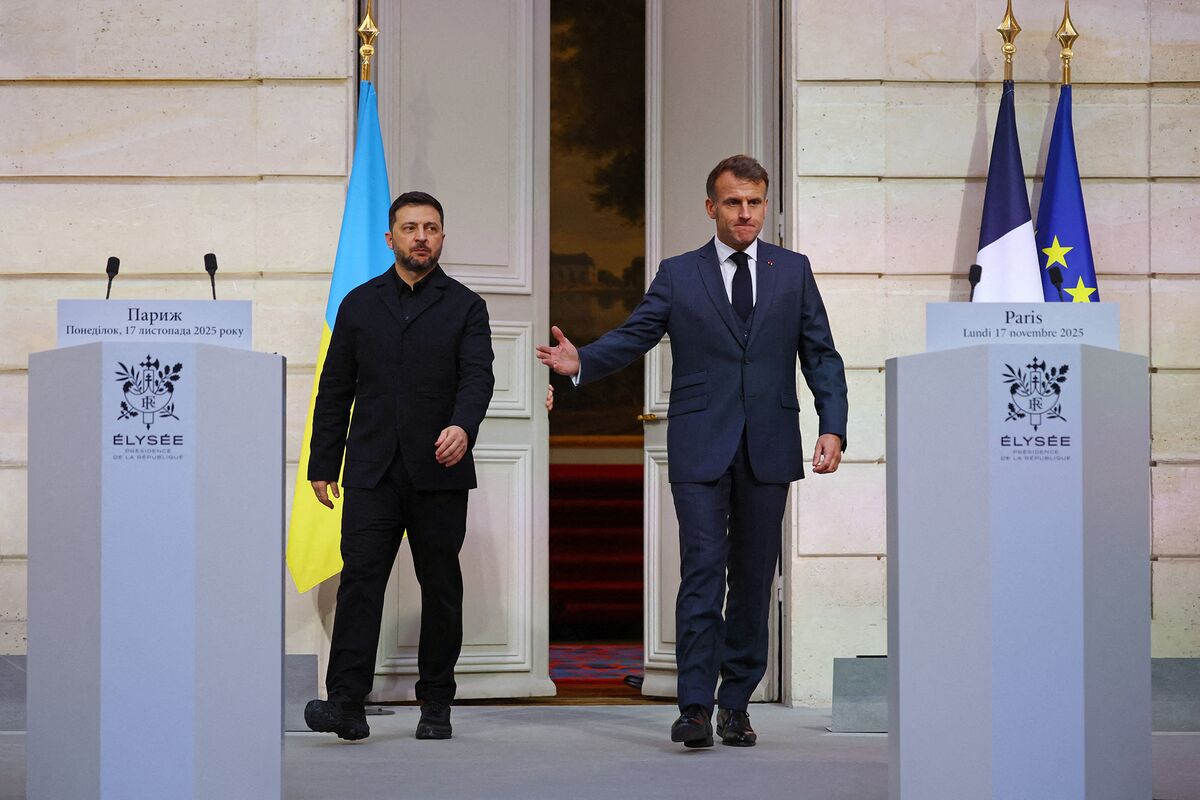
President Emmanuel Macron will host Ukrainian President Volodymyr Zelenskiy in Paris on Monday to discuss conditions for a “fair and lasting peace” tied to a US-led peace plan; the meeting comes as France and other allies intensify support while Kyiv faces domestic and European pushback over the proposal. The talks could shape diplomatic momentum around the plan and will be watched for signals that might alter geopolitical risk assessments and related investor positioning in defense and regional exposure.
Market structure: Macron–Zelenskiy talks increase the probability of either (A) a short-term de‑risking if a credible roadmap toward a US-led plan emerges or (B) renewed risk premium if talks falter. Winners (conditional): defense primes (RTX, LMT, GD, ETF ITA) and energy suppliers if fighting persists; losers: European travel, insurers and regional banks sensitive to geopolitical risk. Cross-asset: risk-on reduces safe‑haven demand (bonds down, yields +20–50bp on Europe if peace prospects improve within 4–8 weeks); risk-off lifts USD and gold (GLD) and Brent crude (+5–12% on escalation within 1–3 months).
Risk assessment: Tail risks include rapid escalation to wider energy cutoffs (Brent >$100/bbl within 30–90 days) or NATO friction prompting sanctions that tighten supply chains for European defense suppliers. Immediate (days): event volatility spike around the Paris meeting; short (weeks): headline-driven swings ±5–12% in listed names; long (quarters): multi-year procurement paths sustain defense revenues. Hidden dependencies: European political backlash to concessions could delay funding approvals or reroute aid, amplifying volatility.
Trade implications: Near term, favor event-driven option structures (45–60 day straddles on XOP or ITA sized 0.5–1% portfolio) to capture volatility. Medium/long: establish 2–3% directional in ITA (or equally weighted RTX/LMT/GD) for 3–12 months, and 1–2% energy exposure (XOM/CVX or XLE) for commodity upside if talks fail. Hedge positions with 3–6 month protective puts sized 25–50% of equity exposure; scale out on +15–25% moves.
Contrarian angles: The market may underprice the scenario where a mediated compromise materially reduces near‑term defense spending growth — that would compress multiples 10–20% on consensus defense rerating. Conversely, a failed deal could create a rapid 10–20% repricing in cyclical European assets; consider asymmetric structured positions (buy calls in defense, buy puts in European travel/airlines) rather than outright long-only exposure.
AI-powered research, real-time alerts, and portfolio analytics for institutional investors.
Request DemoOverall Sentiment
neutral
Sentiment Score
0.00
