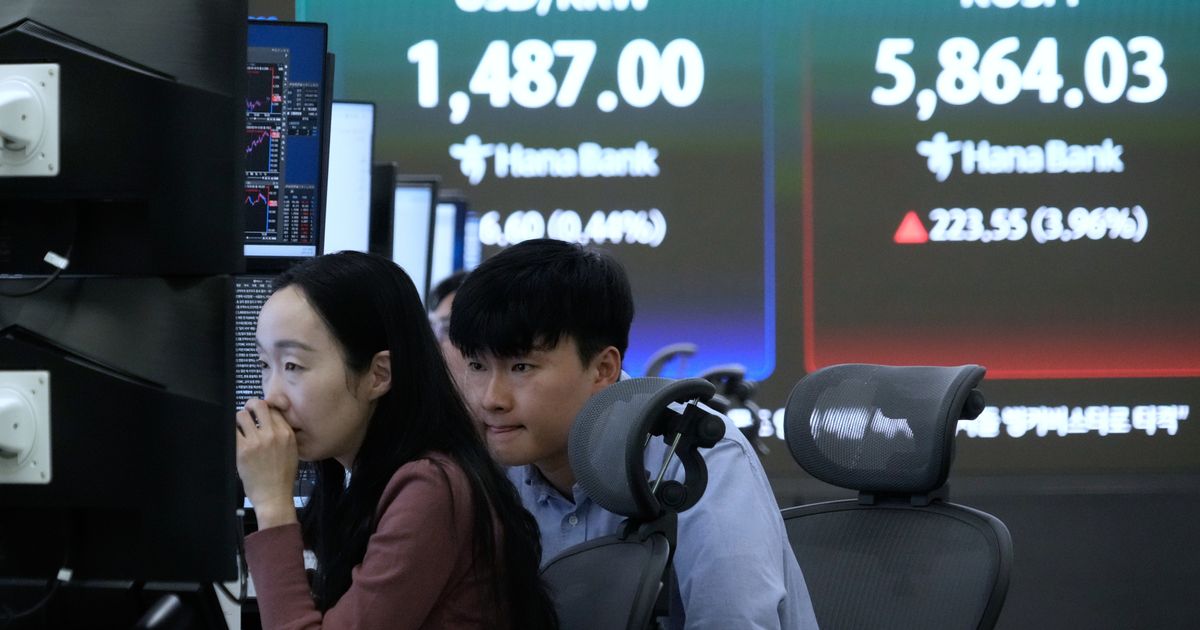
Japan's Nikkei gained 2.6% to 55,106.69 and South Korea's Kospi jumped 3.8% to 5,854.28 as Brent crude slid from above $106 on Monday to roughly $101–$102/bbl and U.S. crude near $93–$94/bbl. U.S. futures rose ~0.4% and major U.S. indexes were modestly higher ahead of a widely expected Fed hold on rates, while markets largely shrugged off Iranian attacks in the Gulf. Delta shares rose 6.6% after raising revenue guidance and Uber jumped 4.2% on an Nvidia autonomous vehicle partnership; FX moved modestly (USD/JPY to 158.85, EUR/USD $1.1539).
Geopolitical skirmishes are currently being priced more as a volatility episodic risk than a structural supply shock, which compresses risk premia across both energy and FX markets for the next several weeks. That creates a window where consumption-linked sectors (notably carriers) can crystallize margin gains from lower fuel volatility before any sustained structural re-pricing of oil occurs; hedging schedules and fuel-roll exposures will determine who captures that benefit. Delta’s revenue resiliency implies airlines with active ancillary and route optimization levers will outperform peers on any durable easing in energy volatility, but this is conditional on fuel hedges rolling at favorable levels over the next 3-9 months. Watch maintenance, crew and airport congestion lines as second-order cost items that can offset the fuel tailwind—these line items are proving to be the marginal cost in the next earnings cycle rather than fuel alone. The Uber–Nvidia tie-up accelerates a commercialization pathway for AV services that benefits platform economics (lower driver opex) mostly in the 12–36 month horizon, while Nvidia captures incremental high-margin compute spend today via simulation and edge compute stacks. That dichotomy argues for asymmetric exposures: long optionality on operators funded by selling short-dated premium on hardware/software providers, rather than straight long hardware at current implied vol. Monetary policy complacency (near-term pause) reduces immediate carry cost for rate-sensitive equities and EM currencies, but a true supply shock out of the Gulf would force a rapid regime shift—expect reversal triggers within days and structural re-pricing within 1–3 months if chokepoints re-close. Position sizing should therefore treat oil as a binary tail risk: small sustained allocations, large, rapid hedges on dislocations.
AI-powered research, real-time alerts, and portfolio analytics for institutional investors.
Overall Sentiment
mildly positive
Sentiment Score
0.12
Ticker Sentiment
