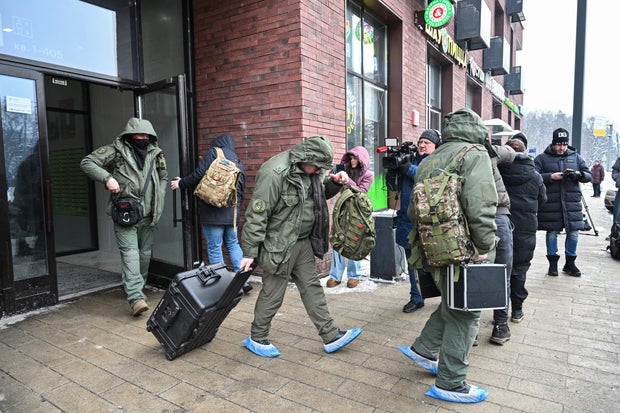
Vladimir Alekseyev, the first deputy chief of Russia's GRU and a Western-sanctioned intelligence figure tied to alleged cyberattacks and the Skripal poisoning, was shot in a Moscow apartment and hospitalized; Russian authorities and Foreign Minister Sergei Lavrov accused Ukraine of orchestrating the attack. The Kremlin has launched an investigation and is keeping President Putin informed amid ongoing U.S.-mediated prisoner-exchange talks, while the incident follows a string of high-profile targeted killings that have raised tensions. For investors, the episode modestly raises geopolitical risk and could pressure risk assets and Russia-exposed positions, particularly in defense and regional markets, though immediate market-moving implications appear limited absent broader escalation.
Market structure: The immediate winners are defense contractors (Lockheed LMT, Northrop NOC, RTX) and cybersecurity names (Palo Alto PANW, CrowdStrike CRWD) as headline risk raises probability of higher Western defense spending by ~3–7% over 3–12 months; losers are Russia-exposed assets (Russian equities/sovereigns, FX) and discretionary travel/retail that reprice geopolitical risk. Cross-asset: expect a mild safe-haven bid (gold GLD +2–5% in days, 5–10% if escalation), US Treasury rallies (10y yield down 10–30bp intraday risk-off), USD/JPY up, RUB weakness >10% shock-case; oil may spike 3–8% on supply-fear contagion but mean-reverts in 2–8 weeks absent supply cuts.
Risk assessment: Tail scenarios include (A) rapid attribution to Ukraine triggering wide sanctions on energy leading to oil >+20% within weeks and European gas shocks, and (B) Russian domestic crackdown causing operational blackouts/cyber retaliation affecting Western firms; both are low probability (<15%) but high impact. Time horizons: immediate (48–72h) for volatility trades, short-term (1–3 months) for defense/cyber outperformance, long-term (3–12 months) for budget-driven re-rating; hidden dependencies include EU gas/grain routes and cyber-interconnected supply chains that can amplify market moves. Catalysts to monitor: official attribution, EU/US sanctions announcements, oil flows/PIPELINE disruptions, and progress/failure of Abu Dhabi-mediated talks over next 7–30 days.
Trade implications: Direct plays favor a 2–3% tactical long to defense ETF ITA or selective names LMT/RTX (3–6 month horizon) and 1–2% tactical cyber longs (PANW, CRWD) as asymmetric plays versus broad market. Use tail hedges: 3-month 5% OTM puts on EEM sized to 0.5–1% notional and 1-month VIX calls (small sized) to protect portfolio for 2–8 weeks; consider pair trade long ITA vs short discretionary/travel ETF XLY to capture relative weakness if headlines persist. Entry: establish within 48 hours on elevated news flow; exit/trim if volatility normalizes (VIX back to <18) or oil moves <+5% from pre-event levels for 2 consecutive weeks.
Contrarian angles: The market may overprice systemic escalation—historical parallels (targeted assassinations in conflicts) often produce short-lived risk-off and rotate rather than crash markets; therefore cap position sizes (2–3% per idea) and prefer liquid ETFs/options. Cybersecurity exposure is likely under-owned relative to headline defense allocations; if attribution remains ambiguous, expect continued targeted operations rather than full escalation, favoring cyber/defense outperformance over commodity or broad safe-haven overweights. Unintended consequence: Kremlin internal instability could disrupt commodity exports indirectly—monitor Jun–Sep shipping/gas flow data and RUB FX moves >10% as triggers to widen hedges.
AI-powered research, real-time alerts, and portfolio analytics for institutional investors.
Request DemoOverall Sentiment
moderately negative
Sentiment Score
-0.35
