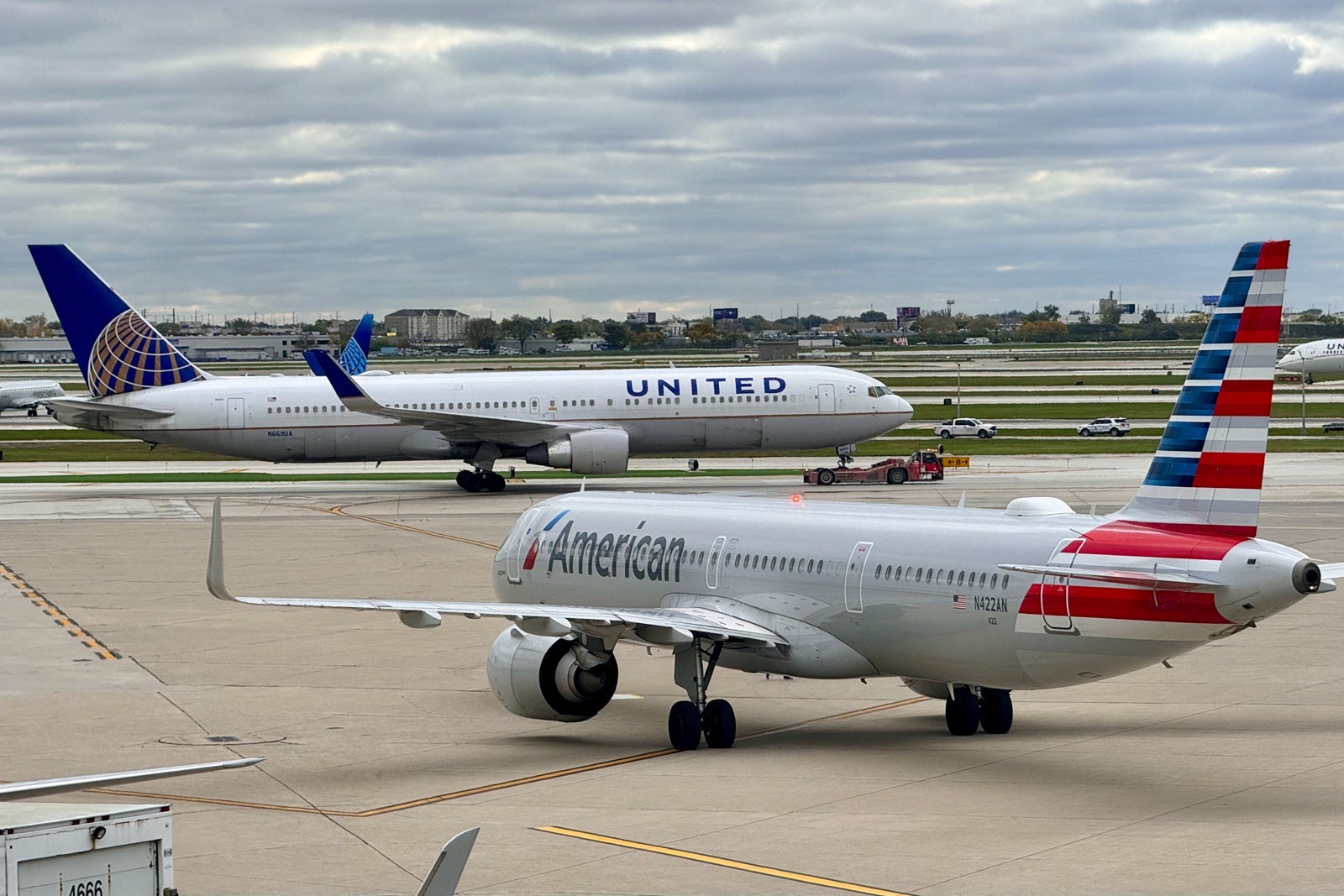
United’s CEO Scott Kirby has publicly drawn a ‘‘line in the sand’’ at Chicago O’Hare, pledging to add flights to hold gate counts against American Airlines’ planned expansion in 2026; United currently holds 95 gates versus American’s 59. Cirium schedule data show United averaged 541 departures/day at ORD in 2025 versus American’s 412, and United claims roughly $500 million profit at ORD in 2025 while estimating American lost about $500 million and could reach ~$1 billion in losses; United has mirrored several of American’s new regional routes. JP Morgan analyst Jamie Baker expects American to remain committed to ORD given its AAdvantage profits and other hub economics, making this an ongoing competitive hub battle with implications for regional capacity, fares and hub profitability rather than a single, market-moving corporate event.
Market structure: United (UAL) is the clear tactical winner — it controls 95 gates and 541 daily departures vs American's (AAL) 59 gates and 412 departures, and management claims ~+$500M profit at ORD in 2025 vs AAL's -$500M (risking up to -$1B). Expect localized fare suppression and capacity-led yield pressure at ORD in 2026 as both carriers add flights; consumers and corporate travel buyers win short-term while AAL suffers margin dilution. Cross-asset: expect AAL equity and high-yield credit to underperform, UAL equity to outperform, elevated options IV for both, and minimal commodity (jet fuel) demand impact beyond incremental flights.
Risk assessment: near-term headline volatility (days) around Kirby/Isom comments and gate allocation updates; weeks–months risk centers on city/DOT gate rulings and schedule filings for 2026; longer-term (quarters–years) hinge on whether AAL leans on AAdvantage and CLT/DFW profits to subsidize ORD. Tail risks include regulatory intervention/antitrust, an unexpected spike in fuel or labor costs, or a litigation/regulatory probe that forces capacity limits. Hidden dependencies: AAL’s loyalty revenue, corporate contracts in Chicago and codeshares can materially mute cash losses.
Trade implications: favored tactical trade is a relative-value pair — long UAL, short AAL equal notional (delta-neutral by market value) sized 1–3% portfolio exposure, horizon 3–9 months to capture gate-allocation and schedule effects. Option sleeve: buy UAL 6–9 month call spreads (target 15–25% OTM buy / 30–40% OTM sell) funded by selling AAL 6-month covered calls or buying AAL puts as downside protection; set stop losses at 20% adverse move and take profits at 25–40% gain. Rotate toward larger, scale carriers and underweight legacy carriers with concentrated hub exposure until ORD dynamics resolve.
Contrarian angles: consensus underestimates AAL’s ability to subsidize ORD from AAdvantage and CLT/DFW — AAL may tolerate losses longer than markets expect, so short crowding risk exists. Historical hub wars (1980s–2000s) show incumbents often retreat only after sustained losses; if AAL demonstrates durable corporate fares or regains 3 gates in early 2026, the UAL outperformance trade could be overstated. Watch for unintended outcomes: protracted price war could invite city or federal capacity limits, reversing the expected short-term winner-loser split.
AI-powered research, real-time alerts, and portfolio analytics for institutional investors.
Request DemoOverall Sentiment
neutral
Sentiment Score
0.00
Ticker Sentiment
