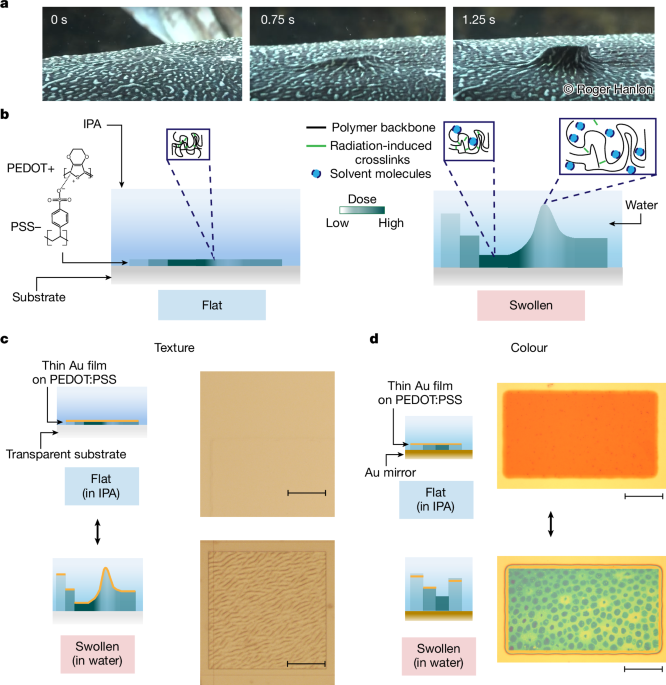
A Nature paper by Doshi et al. describes polymer (PEDOT:PSS) ‘soft photonic skins’ whose surface texture and colour are reversibly programmed by spatial electron‑beam doses that modulate liquid swelling; standard e‑beam patterning encodes arbitrary textures and Fabry–Pérot cavity topography produces tunable colours via microfluidic control. Devices demonstrate robust switching over hundreds of cycles with measured spectral shifts on the order of ~10 nm (flat state) to ~25 nm (swollen state), operate with film thicknesses from ~90 nm up to ~750 nm and dose ranges reported between ~500–10,000 µC cm−2, and the authors have filed a related patent, signalling credible IP and potential commercialization/licensing paths for displays, sensing and camouflage applications.
Market structure: This innovation creates a niche high-margin market for soft photonic skins (defence, AR/VR, wearables, anti‑counterfeiting). Near-term winners are IP holders, advanced lithography service providers and flexible‑electronics integrators; losers are lower‑end pigment/print incumbents whose products can be functionally displaced in targeted use cases. Pricing power will be concentrated (licensing + custom device premiums), but total addressable market (TAM) expansion is years not months — expect supplier bargaining power during initial scale‑up due to constrained e‑beam and microfluidic capacity.
Risk assessment: Tail risks include failure to scale (throughput limits of electron‑beam lithography), IP litigation around the filed patent, and materials/regulatory constraints on PEDOT:PSS (environmental/durability). Immediate market impact is negligible (days); watch for pilots in 3–12 months and commercialization/volume manufacturing in 12–36 months. Hidden dependency: adoption hinges on maskless high‑throughput e‑beam or multicolumn tools (throughput threshold ~>1 wafer/hr) and microfluidic reliability for field devices.
Trade implications: Tactical plays favor selective exposure to AR/VR platform owners (META) and semiconductor fab‑equipment beneficiaries of advanced patterning demand (AMAT, KLAC) with staged allocation over 3–12 months. Avoid or trim long positions in commodity paint/printer names (PPG, SHW) by 1–3% over 6–18 months; allocate saved capital to small allocations in photonics/materials specialists. Volatility is likely idiosyncratic; consider defined‑risk option structures to capture binary partnership proofs.
Contrarian angles: Consensus will underweight throughput risk and overestimate speed of deflationary price curves. If and when multicolumn maskless e‑beam or roll‑to‑roll patterning proves viable (catalyst window 6–18 months), upside could concentrate in a few toolmakers and IP owners; conversely, a focus on licensing revenue (not product sales) could make public OEM beneficiaries (AMAT) underperform expectations. Watch for defense or consumer anchor deals as asymmetric triggers.
AI-powered research, real-time alerts, and portfolio analytics for institutional investors.
Request DemoOverall Sentiment
neutral
Sentiment Score
0.10
Ticker Sentiment
