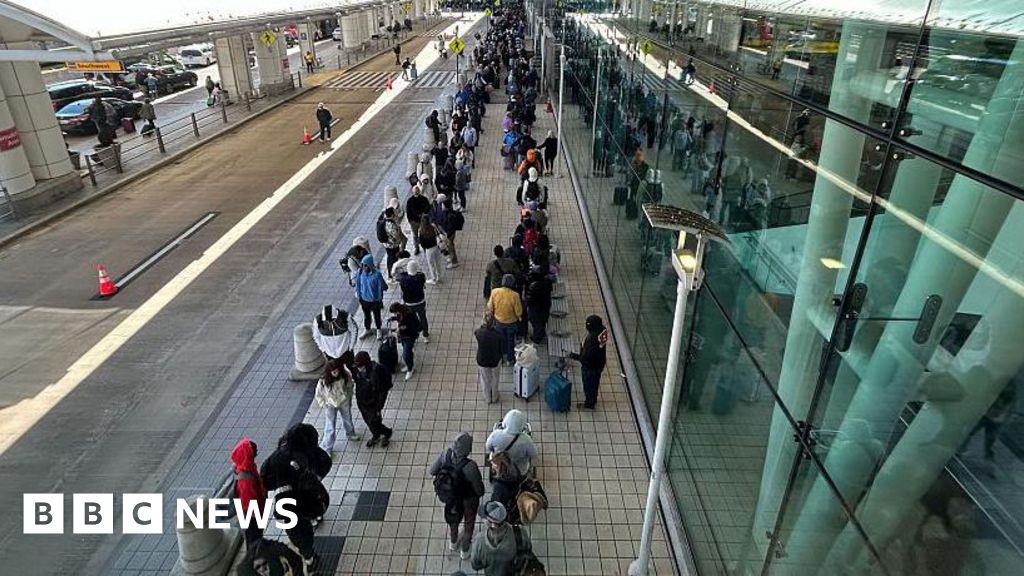
The partial US government shutdown reached 44 days (the longest on record) and has left the Department of Homeland Security closed since 14 February. TSA operational capacity is impaired with ~3,560 officers calling out (12.35% of the workforce) and roughly 500 resignations, producing major airport delays and raising concerns about World Cup readiness. President Trump signed an executive order intended to free cash to pay TSA (payments could start next week), but legal challenges and a congressional impasse mean disruption risks to travel, airlines, and airport operations likely persist.
Operationally, this is a checkpoint-level shock that cascades into scheduling, crew logistics and perishable cargo chains — a sustained reduction in checkpoint throughput of even a few percent forces airlines to trim schedules, which amplifies unit costs (crew deadhead, repositioning) and raises short-term yields but reduces load factor and ancillary revenue. Airports and on-site concessionaires face lumpy revenue losses on high-margin, day-of-travel spend; those losses are front-loaded into monthly cashflow while lease and debt structures remain fixed, creating a two- to three-month cash strain for smaller airport operators and concession-dependent REITs.
Politically and legally, the single biggest near-term catalyst is binary and front-loaded: either a legislative patch or a court-blocked executive workaround. The calendar (major global sporting events and summer travel season) compresses the window for resolution into the next 6–12 weeks, increasing odds of episodic volatility rather than a smooth glide-path back to normal; litigation risk can flip funding flows inside days and precipitate rapid staffing reversals.
From a credit and competitive-dynamics angle, legacy carriers with high fixed-cost structures and elevated leverage are the most exposed to 4–12 week demand disruptions — they are likely to underperform lower-cost carriers that can flex capacity faster. Conversely, defense/homeland-security contractors with existing DHS relationships are asymmetric beneficiaries if back-pay or stop-gap funding routes are validated, creating a potential 6–12 month procurement uplift as agencies backfill capability gaps with contractors.
Contrarian signal: market participants headline-react to passenger queues but frequently underprice the revenue recapture effect once staff returns and airlines re-optimize schedules; a meaningful part of the shock is operational and reversible within 4–8 weeks if funding is restored, which creates short-window tactical shorts but also potential quick mean-reversion trades on oversold names.
AI-powered research, real-time alerts, and portfolio analytics for institutional investors.
Request DemoOverall Sentiment
strongly negative
Sentiment Score
-0.60
