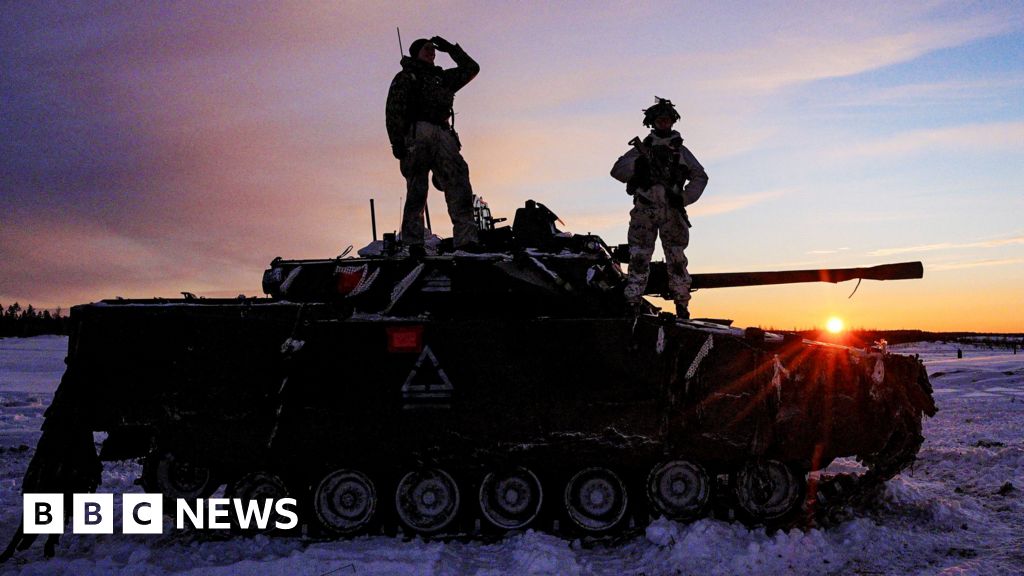
Rising US unilateralism under the Trump administration—illustrated by punitive tariffs, a hardline US National Security Strategy urging Europe to 'stand on its own feet', and high-profile episodes such as the Greenland crisis and last year’s JD Vance speech—has injected fresh uncertainty into transatlantic defence ties ahead of the Munich Security Conference, which will host US Secretary of State and National Security Adviser Marco Rubio and more than 50 world leaders. With NATO cohesion questioned (the article highlights the 'Narva test' over Article 5) and defence-spending imbalances noted (Russia >7% of GDP, UK ~2.5%, several NATO members below 2%), investors should price increased geopolitical risk and potential trade/defence policy shifts into European and defence-sensitive assets.
Market structure: The immediate winners are defence and energy suppliers — European primes (Rheinmetall RHM.DE, Leonardo LDO.MI, BAE BA.L) and global arms exporters (Lockheed LMT, RTX) — as a firming European defence remit would reallocate public capex by an incremental 0.5–1.0% of EU GDP over 12–36 months supporting 10–30% order-book growth for tier‑1 names. Losers: euro‑sensitive cyclicals (consumer discretionary, travel) and exporters to Russia that face sanctions or tariffs. Cross‑asset: expect EUR weakness vs USD (target 1.00–1.05 bands near‑term), higher oil/gas volatility, gold and Treasuries as safe havens, and widening peripheral spreads vs Bunds if US support doubts persist.
Risk assessment: Tail risks include a NATO test scenario (5–15% probability) that would spike oil +30–60% and defence stocks +40% while collapsing risk assets; a milder outcome is renewed tariff/migration flashpoints that widen equity volatility 20–40% over weeks. Immediate catalyst: Munich Security Conference (days); short term (weeks–months) for headlines and FX; long term (quarters–years) for budget reallocation and procurement cycles. Hidden dependencies: export controls, semiconductor supply for missiles/aircraft, and national procurement bureaucracies that can delay delivery by 6–24 months.
Trade implications: Tactical plays: buy defence equities and long energy (LNG) names, hedge EUR downside and peripheral credit. Use options for asymmetric exposure: EUR puts and VIX calls into the conference; 6–12m calls on defence names to capture procurement upside. Rotate away from European travel/consumer names into defence/energy over 1–3 months; scale positions as formal EU defence budget signals appear.
Contrarian angles: Markets underprice multi‑year European strategic autonomy — procurement shifts are structural not cyclical and will favor EU primes and local supply-chains (machinery, semiconductors for defence). The knee‑jerk USD/Euro move may be overdone by 5–15% if follow‑through spending boosts EU capex and exports. Historical parallel: post‑2014 Ukraine saw sustained defence order flows; expect a similar multi‑year re-rating rather than a short blip. Unintended consequence: shortage of specialised components (RF, power electronics) could create 6–18 month bottlenecks and margin upside for niche suppliers.
AI-powered research, real-time alerts, and portfolio analytics for institutional investors.
Request DemoOverall Sentiment
moderately negative
Sentiment Score
-0.45
