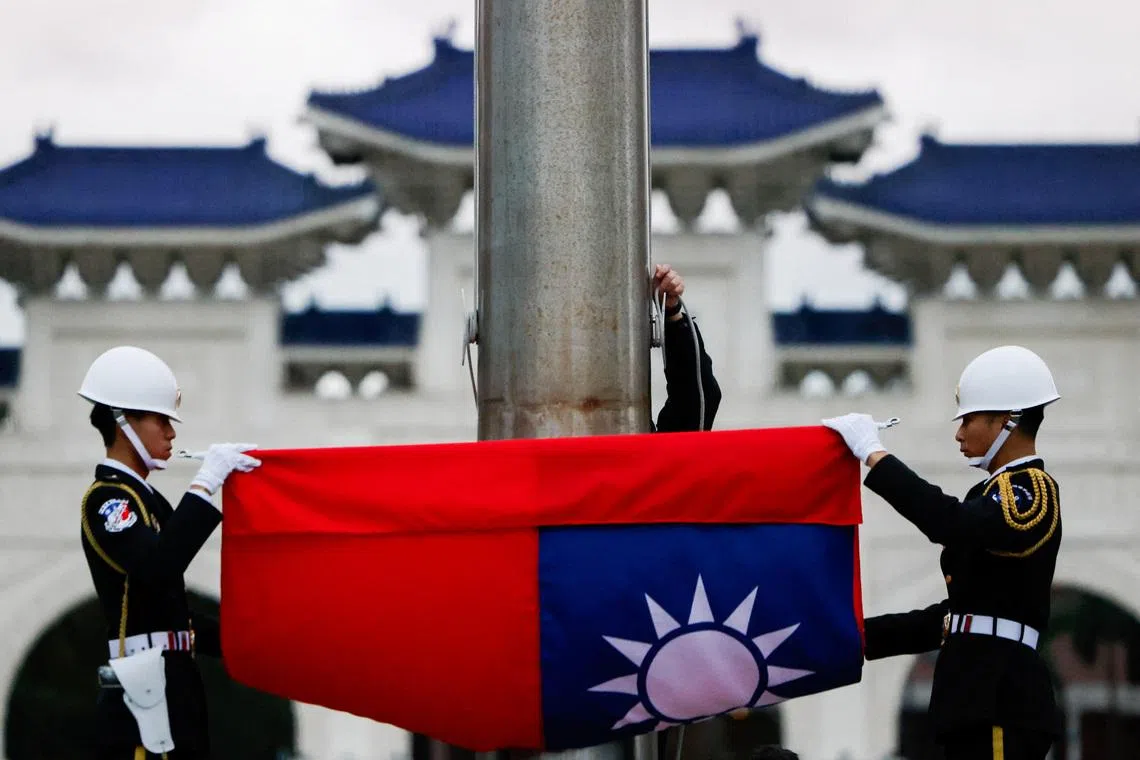
China conducted its largest-area war games to date around Taiwan in exercises dubbed “Justice Mission 2025,” deploying 77 military aircraft and 25 navy/coast guard vessels in the past 24 hours, with 35 planes crossing the Taiwan Strait median line; the drills forced Taiwan to cancel dozens of domestic flights. Taiwan kept military and coast guard emergency response centers active as Chinese ships began withdrawing but Beijing had not formally declared the exercises over; the drills came 11 days after the US announced an $11.1 billion arms package for Taiwan, heightening regional risk and potential short-term market risk aversion, particularly in Asian equities, transportation and defense-related sectors.
Market structure: Immediate winners are defence suppliers and aerospace integrators (US primes and their supply chains) as incremental arms sales and perceived need for replenishment lift order visibility and pricing power; losers are Taiwan domestic transport, regional carriers and Taiwan-heavy equities (semis, airlines, logistics) from disrupted operations and higher risk premia. Expect short-lived freight/airlift dislocations (days–weeks) that tighten effective transport capacity and push spot freight insurance/pricing up 5–20% in pockets.
Risk assessment: Tail risks include kinetic escalation (blockade, strike on fabs) that would create a global semiconductor shock (up to 30–50% revenue hit for Taiwan-centric supply nodes in worst case) and broader sanctions/countermeasures that impair trade flows. Timeline: immediate (days) = volatility, cancellations, flight/freight disruption; short-term (weeks–months) = order-book reallocation, defence capex; long-term (quarters–years) = supply‑chain reshoring and higher inventory levels. Hidden dependencies: insurance, port capacity and subcontractor footprints amplify semiconductor and logistics impact.
Trade implications: Tactical trades favor long defence exposure, short Taiwan equity sensitivity, and safe‑haven duration/gold hedges. Use options to cap downside on Taiwan exposure and to express convex bullishness on defence names. Cross‑asset: expect USD and JPY strength, CNY downside stress, US Treasuries tightening yields (buyers), and higher gold; volatility will lift option premia 30–80% on Taiwan/Asia underlyings in near term.
Contrarian angles: Markets often overshoot — 1996 Taiwan Strait drills produced a sharp but short-lived hit to equities; absent casualties or blockade, Asian risk premia can revert within weeks. If EWT/TSM price falls >12% on headline risk without kinetic escalation, mean reversion trade is attractive; conversely, defence names can be crowded so watch valuation (avoid >25% runups). Unintended consequence: rapid defence reallocation can create supply bottlenecks for primes, lifting small-cap suppliers more than large-cap primes.
AI-powered research, real-time alerts, and portfolio analytics for institutional investors.
Request DemoOverall Sentiment
moderately negative
Sentiment Score
-0.45
