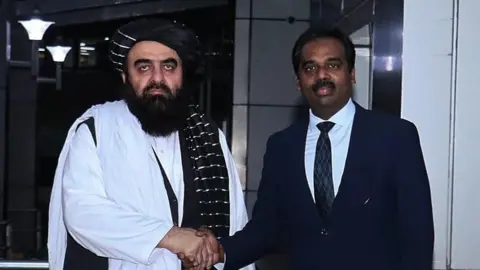
Afghan Taliban Foreign Minister Amir Khan Muttaqi's unprecedented visit to India for diplomatic, trade, and economic talks signals a significant pragmatic shift in India's Afghan policy, highlighted by the reopening of its embassy in Kabul. This engagement, driven by India's security concerns and desire for regional connectivity against China and Pakistan, also allows the Taliban to seek legitimacy and reduce its reliance on Pakistan amidst worsening ties between Islamabad and Kabul. The visit underscores a cautious reset in India-Taliban relations, prioritizing strategic interests and reshaping regional power dynamics, particularly given the backdrop of deteriorating Pakistan-Taliban relations.
The unprecedented visit of Afghan Taliban Foreign Minister Amir Khan Muttaqi to India, the highest-level engagement since 2021, signals a significant pragmatic shift in India's foreign policy towards Afghanistan. This eight-day visit, focusing on diplomatic, trade, and economic ties, culminates in India's decision to reopen its embassy in Kabul, which was closed four years ago. This move underscores India's strategic re-engagement, prioritizing realpolitik over past ideological stances.
India's renewed engagement is primarily driven by national security concerns, particularly regarding Islamic State and al-Qaeda activities, and a strategic imperative to deepen connectivity with Iran and Central Asia to counter Chinese and Pakistani regional influence. The Taliban, in turn, seeks international legitimacy and aims to reduce its historical over-reliance on Pakistan, especially amidst worsening ties between Islamabad and Kabul. This mutual interest forms the basis of a cautious, tactical relationship.
The visit significantly alters regional power dynamics, representing a setback for Pakistan, which historically held close ties with the Taliban. While the engagement is seen as a cautious reset, both sides acknowledge the tactical nature of their relationship due to past reservations and potential foreign repercussions. The UN sanctions exemption for Muttaqi and Russia's full recognition of the Taliban government highlight the complex international landscape surrounding this development, indicating a moderately positive but cautious outlook.
The re-establishment of diplomatic ties and potential for increased trade and connectivity, despite the underlying geopolitical complexities and sanctions environment, suggests a recalibration of regional influence. This development aligns with themes of Geopolitics & War, Trade Policy & Supply Chain, and Sanctions & Export Controls, with a moderate market impact score reflecting the cautious optimism.
AI-powered research, real-time alerts, and portfolio analytics for institutional investors.
Request DemoOverall Sentiment
moderately positive
Sentiment Score
0.50
