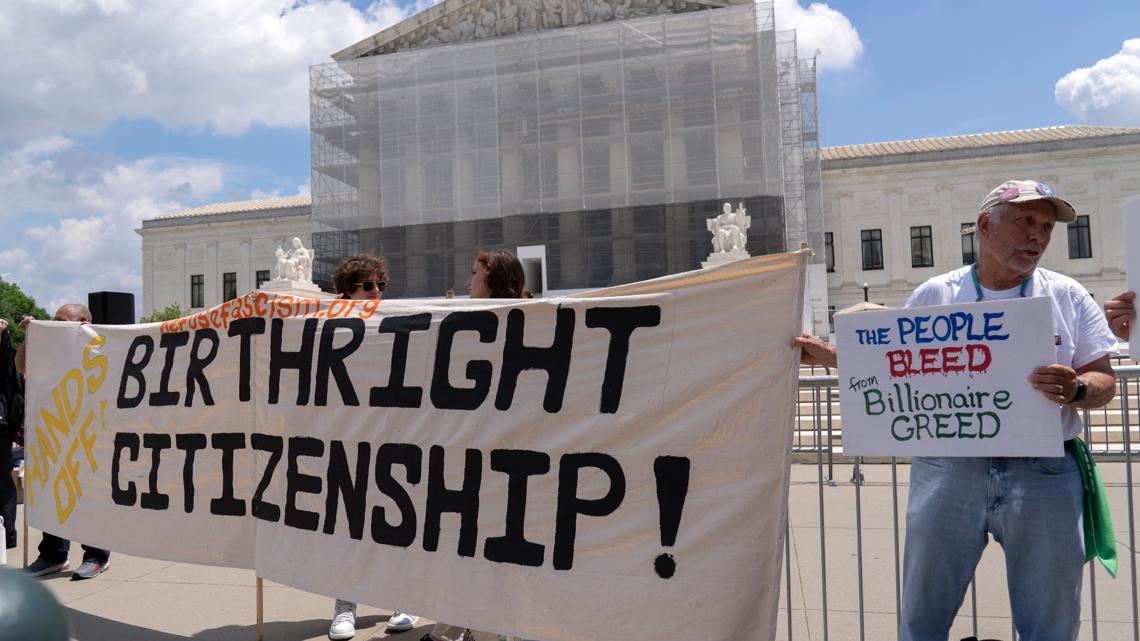
The Supreme Court is hearing the Trump administration's appeal of a New Hampshire judge's ruling that the executive order to end birthright citizenship likely violates the 14th Amendment; multiple federal courts have uniformly blocked the order and it has never taken effect. Judges at district and appellate levels have cited the 1898 Wong Kim Ark precedent and historical/textual analysis to find the order unconstitutional, with three liberal justices signaling they would strike it down. Near-term market impact is negligible, though the ruling has material political and policy implications ahead of upcoming elections.
The judiciary’s reinforcement of constitutional limits on abrupt executive policy changes materially increases the expected cost of achieving immigration goals via executive fiat, shifting the likely battleground to legislatures and state-level actions. Expect two second-order dynamics: (1) firms that rely on a stable, low-cost immigrant labor pool face a higher probability of labor-policy churn over 1–3 years (raising capex-to-replace labor and near-term wage pressure) and (2) firms with scale and compliance budgets will gain share as fragmentation forces more complex multi-jurisdictional HR and legal overhead. Quantify: budget-constrained quick-service restaurants and seasonal agriculture users showing >10% workforce churn historically will accelerate automation or logistics capex if uncertainty persists, suggesting a 12–36 month reallocation of capital toward labor-saving equipment.
Near-term (weeks–months) the key catalysts are filings, emergency stays, and election-driven legislative proposals — any news flaring these items will spike political/legal volatility well above realized equity vol. Over 6–18 months, watch state-level enforcement proposals and federal legislative activity; either could produce asymmetric outcomes (patchwork compliance costs vs. a uniform federal statute) that disproportionately hurt small operators. Tail risks include an unexpected narrow ruling that invites renewed executive attempts or a rapid shift to legislative fixes; both would re-price regulatory risk for impacted sectors.
From a market-structure angle, the winners are capex-rich industrial automation and large-cap consumer staples/tech firms that can absorb compliance complexity; losers are regionally concentrated small-cap operators with thin margins and high exposure to low-skill labor. For portfolios, the trade-off is political-volatility hedging (short-duration protection) versus thematic rebalancing into labor-substitution beneficiaries over the next 12–36 months. Keep position sizes modest given binary legal outcomes and possible snap reversals tied to election cycles.
AI-powered research, real-time alerts, and portfolio analytics for institutional investors.
Request DemoOverall Sentiment
neutral
Sentiment Score
0.00
