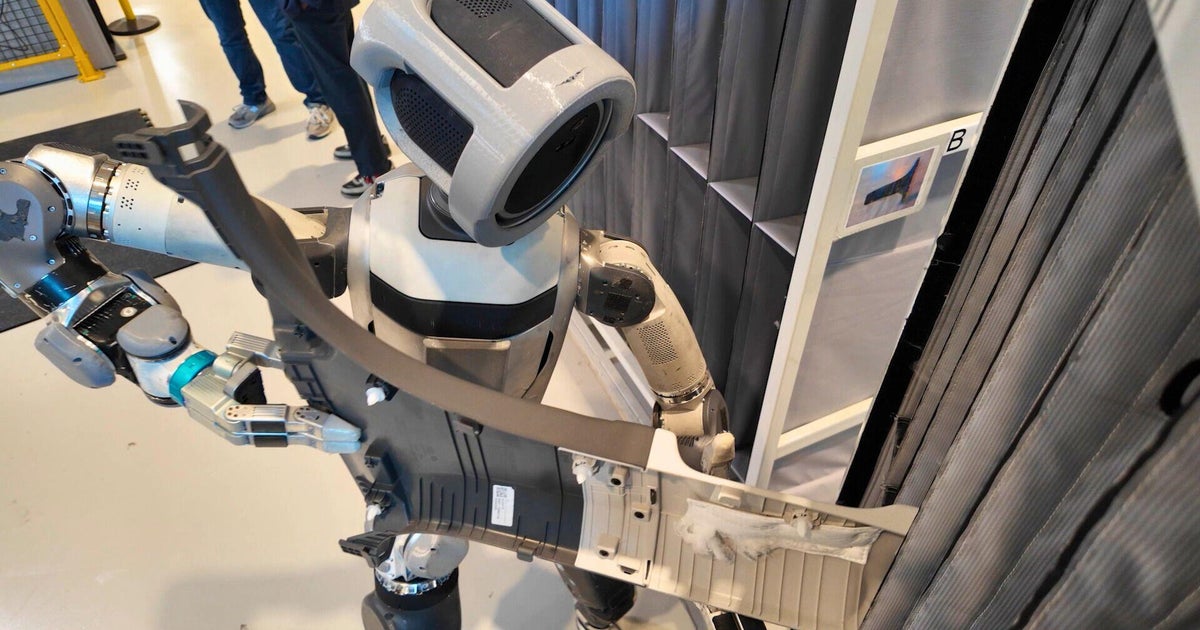
Boston Dynamics, 88% owned by Hyundai, is field-testing its AI-powered humanoid Atlas (5'9", 200 lb) at Hyundai's Georgia plant to autonomously sort roof racks, using Nvidia chips and a mix of supervised learning, motion-capture demonstrations and large-scale simulation (over 4,000 digital Avatars trained for six hours). Goldman Sachs projects a $38 billion humanoid market within a decade, while management cautions commercialization will take years and highlights competition from state-backed Chinese firms; implications include long-term addressable-market upside for robotics and AI suppliers (and potential labor-replacement effects), but limited near-term revenue impact for incumbent public companies.
Market structure: Near-term winners are GPU suppliers (NVDA) and industrial-automation integrators (Rockwell ROK, ABB), plus metals and power suppliers tied to robot build cycles; losers include low-skill staffing firms (MAN) and marginal auto-parts suppliers facing capex-led productivity substitution. Nvidia’s pricing power should remain intact over the next 3–12 months as demand for training/inference GPUs outstrips supply; Goldman’s $38bn humanoid TAM by 2030 implies concentrated downstream spend but does not dilute semiconductor capture — expect 10–20% incremental semi TAM contribution over 3 years if adoption accelerates.
Risk assessment: Key tail risks are (1) export controls/subsidy wars that choke off chip supply or scale Chinese competitors, (2) high-profile operational failures or workplace injuries triggering regulation, and (3) a prolonged Nvidia capacity shortfall spiking input costs. Immediate (days) volatility will hinge on NVDA earnings and Hyundai pilot announcements; medium (months) risks center on chip supply and pilot success rates; long (years) risks include regulation and labor pushback. Hidden dependencies include access to large-scale simulation compute and training datasets — these are gatekeepers that favor incumbents.
Trade implications: Direct plays: overweight NVDA via 3–6 month call spreads to capture enterprise GPU demand; add 12–24 month exposure to ROK/ABB for systems integration. Pair trade: long NVDA (2–3% portfolio) / short MAN (1% portfolio) to express automation vs staffing. Options: buy NVDA 6-month ATM call + sell 6-month +50% call to finance; hedge industrial exposure with 9–12 month 10% OTM puts on XLI sized to a 2% portfolio cost. Entry: act within 30–90 days for NVDA, scale industrial names over 3–12 months.
Contrarian angles: The market underestimates adoption lag — humanoid deployment in high-mix factories will likely take 3–7 years, not 1–2, creating room for mean reversion in euphoric semi multiples. Competition from Chinese state-backed players could compress robotics integrator margins; history (industrial robot rollouts in autos) shows capital intensity and regulatory friction can delay commercialization and cap rates on returns. Unintended consequences: faster robot adoption could trigger wage-support regulation or tariffs that raise total cost of ownership and slow ROI, flipping winner/loser outcomes.
AI-powered research, real-time alerts, and portfolio analytics for institutional investors.
Request DemoOverall Sentiment
mildly positive
Sentiment Score
0.30
Ticker Sentiment
