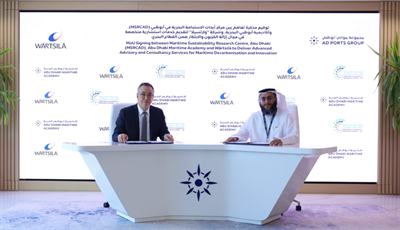
Wärtsilä has signed a five-year Memorandum of Understanding with Abu Dhabi Maritime Academy to collaborate on maritime decarbonisation, digitalisation, smart port solutions and training, with the Maritime Sustainability Research Centre Abu Dhabi advising and potential expansion into GCC government collaborations. The partnership positions Wärtsilä Marine to provide advisory services and early involvement in customer projects that could expand its decarbonisation and lifecycle service offerings in the UAE/GCC market. Wärtsilä reported 2025 net sales of EUR 6.9 billion and employs ~17,900 staff across 199 locations, underscoring its scale to pursue regional advisory and service-led revenue opportunities.
Market structure: The MoU is a positive marginal demand signal for marine decarbonisation vendors — direct winners are integrated solution providers (Wärtsilä (WRT1V.HE), ABB (ABBN.SW), Kongsberg (KOG.OL)) and smart-port technology suppliers; losers are legacy low-margin engine-only vendors and shipowners facing retrofit CapEx. Expect 200–400bp gross-margin tailwind over 12–24 months for firms that convert advisory work into performance-based service contracts; pricing power shifts toward firms offering end-to-end digital+fuel solutions.
Risk assessment: Tail risks include GCC political shifts or subsidy re-prioritisation, technology risk (ammonia/hydrogen adoption failure), and supply-chain bottlenecks for power electronics that could delay roll-outs 6–18 months. Immediate (days) effect is muted sentiment; short-term (weeks–months) is pipeline visibility and tender announcements; long-term (12–36 months) is where revenue and margin capture occur. Hidden dependencies: local-content rules and government-to-government procurement could lock revenues but compress margins.
Trade implications: Tactical trades — establish a 2–3% long position in WRT1V.HE via stock or purchase a 12-month call spread (buy 0.8x delta, sell 0.4x delta ~+15% OTM) to target +20–30% upside, stop -12%. Pair trade: long WRT1V.HE (2%) vs short Fincantieri (FCT.MI) (1.5%) to express tech-over-shipbuilder tilt. Rotate 3–5% from cyclical shipowners (e.g., FRO) into ABBN.SW and KOG.OL for electrification exposure; enter within 2–6 weeks, reassess at 6 and 12 months.
Contrarian angles: The market may overrate immediate revenue from MoU—historically Siemens/port deals took 18–36 months to become material; downside is advisory-only work that never converts (>30% probability). Conversely, the market may underprice GCC follow-on spending: a single sovereign-backed pilot could generate >€100–300m in contracts within 12–24 months, rapidly re-rating suppliers. Watch for IP/localisation clauses that could materially reduce gross margins and should trigger trimming positions.
AI-powered research, real-time alerts, and portfolio analytics for institutional investors.
Request DemoOverall Sentiment
mildly positive
Sentiment Score
0.28
