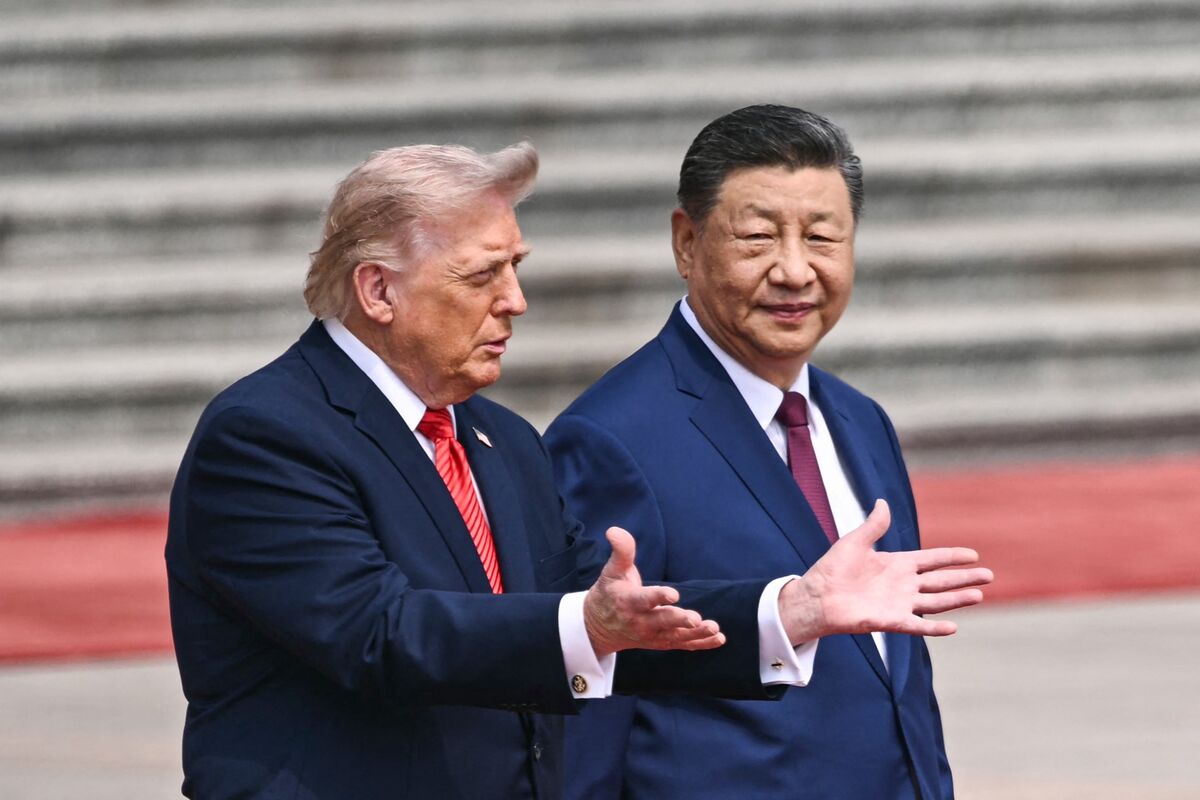
Donald Trump met Xi Jinping in Beijing, marking the first visit by a sitting U.S. president to China in nearly a decade. The summit underscores ongoing geopolitical tensions, including simmering concerns over Iran, but the article does not report any concrete policy announcements or market-moving outcomes.
The real market significance is not the optics of the summit itself but the signaling around coordination risk: when Washington and Beijing are engaged at the highest level, the near-term tail on tariff escalation, export-control surprises, and shipping/tech retaliation usually compresses. That tends to support cyclicals and global risk assets tactically, while reducing the odds of a disorderly policy shock that would hit semiconductor supply chains, industrials, and Asia-exposed multinationals first. The second-order effect is that this kind of diplomacy often benefits the “middle layer” of the global economy more than the headline participants. Freight, logistics, and hardware firms with cross-border exposure can get a relief bid if the market prices lower friction, but the biggest underappreciated winner is usually companies with stretched China revenue dependencies and weak pricing power — because even a modest de-risking narrative can re-rate earnings multiples by 50-100 bps over a few weeks. The contradiction here is that summit optimism can be temporary if the underlying issue set remains unresolved. Over a 1-3 month horizon, any follow-through depends on whether the dialogue produces concrete trade or export-control relief; absent that, this can fade into a “risk-on headline” rather than a durable regime shift. The Iran angle adds a separate catalyst path: if tensions widen, energy and defense exposures can decouple from the China détente story, creating a bifurcated market rather than a broad normalization trade. Consensus may be underestimating how little needs to be announced for the market to react. In a low-conviction macro tape, even incremental de-escalation can trigger systematic buying in Asia equities and semis, while a lack of substantive deliverables after the pageantry would likely reverse the move quickly. The trade is less about believing in lasting rapprochement and more about exploiting the gap between headline diplomacy and actual policy implementation.
AI-powered research, real-time alerts, and portfolio analytics for institutional investors.
Request DemoOverall Sentiment
neutral
Sentiment Score
0.00
