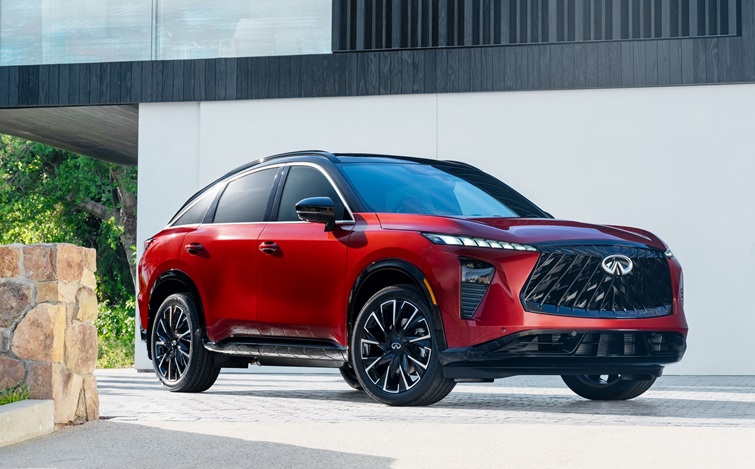
INFINITI will bring the all‑new 2027 QX65 to U.S. retailers in early summer 2026 with a Manufacturer’s Suggested Retail Price starting at $53,990. The fastback luxury SUV emphasizes premium features — VC‑Turbo variable compression engine paired with a 9‑speed automatic and standard Intelligent AWD, dual 12.3" displays with standard Google built‑in, available Klipsch audio and personalized sound tech — and a standout Sunfire Red paint with gold‑coated glass flecks. The product strengthens INFINITI’s offering in the premium SUV segment and could modestly support retail demand and brand positioning, but is unlikely to have a material near‑term impact on the stock or sector performance.
Alphabet’s win here is strategic rather than immediately material: embedded Google services in premium vehicles convert one-off OEM integrations into a recurring, sticky revenue stream (navigation/cloud/assistant/app fees and incremental ad impressions). Conservative back-of-envelope: if OEMs roll Google built-in into 1–2M new premium cars over 24–36 months and monetization averages $50–150/vehicle/year, that’s $50–300M incremental annual revenue with gross margins north of 60%; the EPS lift is modest short-term but compounds via data network effects and higher lifetime ARPU per user.
Second-order supply-chain effects favor vendors tied to richer in-cabin compute and content: higher-spec head units, telematics modems, OTA-capable ECUs, and premium audio suppliers see ASP and software-rev expansion. This increases semiconductor and software services content per vehicle over the next 3 years, raising replacement cycle value and aftermarket subscription potential — a structural demand tailwind for companies that capture the software stack and update infrastructure.
Key risks and catalysts are timing and regulation. Adoption is gated by OEM cadence and dealer economics (luxury-retail conversion takes quarters), while privacy/antitrust pushback or data restriction policies could blunt location-based monetization within 6–24 months. Watch OEM deployment schedules (early summer 2026 retail arrival is a discrete near-term sales/PR test), Alphabet’s disclosures on Automotive Services uptake, and any regulatory guidance on in-car data monetization.
Contrarian view: markets underprice the strategic value of in-car system control — owning the primary consumer interaction window (maps, voice, payments) looks like mobile OS dominance in slow motion and can justify multiple expansion if execution is smooth. Offsetting that, Apple retains a powerful defense via iPhone lock-in and privacy branding; if Apple pivots to revenue-sharing in-car or deepens CarPlay hooks, Alphabet’s pathway to monetization becomes harder and faster to reverse than investors expect.
AI-powered research, real-time alerts, and portfolio analytics for institutional investors.
Request DemoOverall Sentiment
mildly positive
Sentiment Score
0.35
Ticker Sentiment
