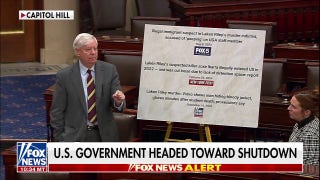
Sen. Lindsey Graham is blocking Senate consideration of a Trump- and Schumer-brokered government funding package ahead of the midnight funding deadline, objecting to a House-inserted repeal of a law that lets senators sue for up to $500,000 per infraction over subpoenaed phone records. Graham says he'll lift his hold only if he secures votes expanding who can sue related to the Arctic Frost probe and on his sanctuary-city criminalization bill; other senators are also demanding amendment votes. The dispute raises the risk of delay or a shutdown and adds political uncertainty to the funding process in the hours before the deadline.
Market structure: The immediate winner is short-duration safe-haven exposure (T-bills, SHV) and longer-duration Treasuries (TLT/IEF) if a shutdown raises growth risk; losers are federal-dependent sectors — DHS-focused defense/primes (LHX, LMT, NOC), federal IT contractors, and small-cap consumer names sensitive to confidence. Pricing power shifts toward liquid high-quality credits and cash; government-contractor receivables and working-cap lines could see payment delays, pressuring smaller vendors and regional banks with outsized federal revenue exposure.
Risk assessment: Tail risks include a multi-week shutdown (>2 weeks) shaving ~0.1–0.3% GDP/week and triggering a 50–150bp swing in front-end funding spreads; a short, last-minute patch keeps impact muted. Near-term (0–7 days) expect volatility spikes and funding-market repricing; medium (1–3 months) sees slower bill receipts and earnings revisions for federal-dependent firms; long-term (quarters) political uncertainty raises idiosyncratic regulatory risk around legislated riders (sanctuary-city criminalization, litigation repeal votes).
Trade implications: Tactical: hedge equity beta and buy tail protection while selectively shorting federal-revenue-sensitive names. Use options to cap cost: 2–3% portfolio-sized long TLT position if shutdown probability >30% within 72 hours (target 3–5% price move), purchase 1.0–1.5% notional 4-week IWM 2%/5% put spreads, and initiate a 1% pair trade short LHX vs long CAT for 3 months to capture DHS funding risk relative to broad industrial demand.
Contrarian angles: Consensus underestimates speed of legislative fixes — a quick patch would create mean-reversion in defense names; set opportunistic buy triggers (accumulate LMT/NOC if down >7% intraday and sentiment indicators spike). Hidden dependency: regional banks with federal-contractor loan concentration could see deposit reallocation; monitor Senate holdout count and Speaker amendment outcomes as binary catalysts.
AI-powered research, real-time alerts, and portfolio analytics for institutional investors.
Request DemoOverall Sentiment
mildly negative
Sentiment Score
-0.25
