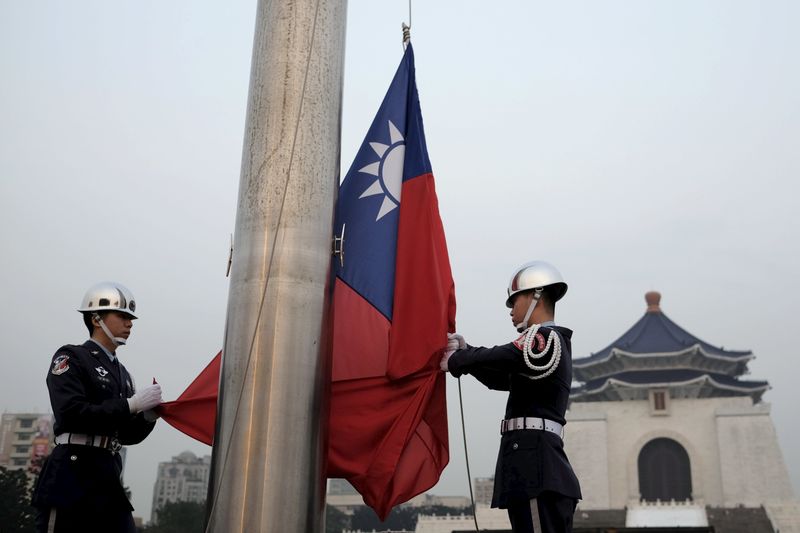
Taiwan's benchmark Taiwan Weighted fell 0.96% as decliners outnumbered advancers, with Avision, Unimicron, and Onano posting gains of 9.98%, 9.96%, and 9.94% while Holy Stone, Yeong Guan Energy, and Chung Fu Tex dropped 9.96%, 9.92%, and 9.51%. Commodities were softer, with June crude down 0.88% to $101.04, July Brent down 0.72% to $107.39, and June gold futures down 0.85% to $4,605.11. USD/TWD eased 0.11% to 31.59 and the U.S. Dollar Index futures were down 0.04% at 97.96.
The market is treating the Hormuz escort headline as a modest risk-premium event, but the more important signal is that shipping insurance, war-risk premia, and voyage times can reprice faster than spot crude. That means the first-order move may stay contained in oil, while the second-order winners are likely to be defense/logistics/insurance beneficiaries and exporters with already-committed inventory, not broad energy beta. In Taiwan, the stock-level dispersion looks more like flow-driven rotation than a macro read-through; names hitting highs/lows on a down tape often indicate crowded positioning and forced rebalancing, which can persist for days even if the macro impulse fades. Crude and Brent are down despite the geopolitically supportive headline, which suggests traders are still anchored to near-term inventory and demand concerns rather than supply disruption. That is important because if escort operations reduce perceived tail risk without changing actual throughput, the crude curve can stay soft even as front-month volatility rises. The key second-order risk is that a failed escort or a single large incident would likely widen prompt spreads and sharply lift refined-product cracks before headline crude reacts, creating a faster trade in distillates and tanker rates than in WTI itself. FX is signaling mild risk-off in the dollar versus TWD, but the move is too small to infer a durable macro regime shift. If anything, Taiwan-sensitive semiconductor supply chains may be the latent beneficiary if lower oil and a stable USD reduce input-cost pressure and preserve Asia manufacturing margins over the next few weeks. The contrarian takeaway is that the market may be underpricing volatility rather than direction: the premium is not for sustained higher oil, but for a fatter left tail in freight, insurance, and energy logistics over the next 1-3 months.
AI-powered research, real-time alerts, and portfolio analytics for institutional investors.
Overall Sentiment
neutral
Sentiment Score
-0.10
