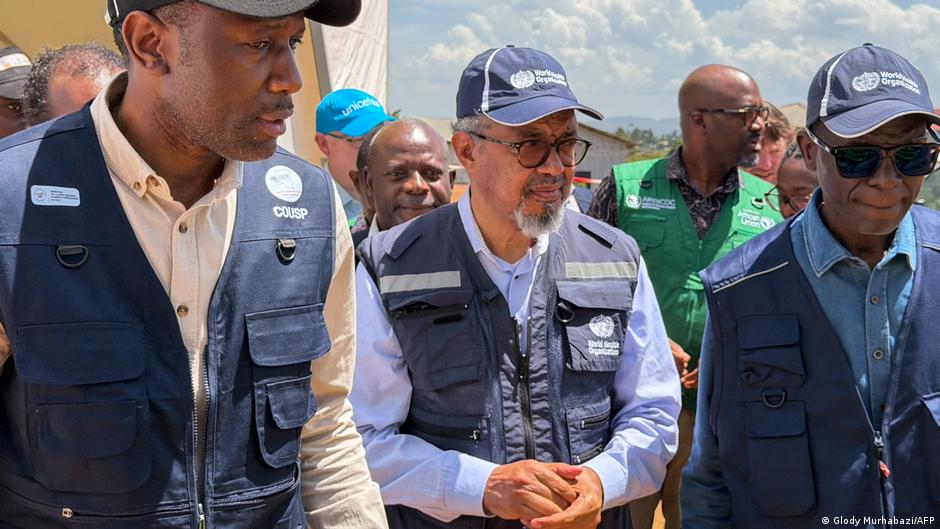
DR Congo’s Ebola outbreak has reached at least 1,077 suspected cases and 246 deaths, with at least nine confirmed cases in Uganda and one death reported in Kampala. WHO chief Tedros warned that the Bundibugyo strain has no approved vaccines or treatments and urged safe burial practices, early care, and isolation. The outbreak is unfolding in a conflict-affected region, increasing the risk of wider spread and complicating the public-health response.
This is a classic low-liquidity, high-friction shock: the disease itself is local, but the market impact can spread into EM risk premia, aid-dependent contractors, and border-linked commerce far faster than case counts imply. The bigger second-order issue is operational: conflict, weak surveillance, and funding gaps mean containment odds are driven less by virology than by logistics, trust, and mobility restrictions. That makes the path asymmetric—small improvements in response capacity can cap the event, but any failure in burial protocols, cross-border screening, or transport bottlenecks can extend the drawdown over weeks rather than days.
The most vulnerable exposures are not obvious healthcare winners but frontier and Africa-linked macro assets: local airlines, cross-border transport, insurers with EM catastrophe exposure, and selective consumer names reliant on east DRC trade flows. Border closures may also create a perverse feedback loop: they reduce formal movement while increasing informal crossings, which tends to worsen detection and delay reporting, extending the tail risk window. From a global asset-allocation lens, this is mildly supportive for defensive healthcare and cash-rich large caps versus cyclicals, but the larger effect is a modest risk-off bid in EM FX and frontier debt rather than a broad global equity shock.
The key catalyst to watch is whether treatment-seeking behavior improves quickly; if patients present earlier and isolation is enforced, the market will fade the scare within 2-4 weeks. If not, expect the headline risk to broaden as neighboring countries tighten controls and donors step in with emergency funding, which can paradoxically stabilize sentiment but also validate the severity. The contrarian angle is that the market may be overpricing a pandemic-style global spillover: this is more likely to remain a contained regional humanitarian crisis than a durable global growth event, unless there is a sustained breakdown in containment over the next month.
AI-powered research, real-time alerts, and portfolio analytics for institutional investors.
Request TrialOverall Sentiment
strongly negative
Sentiment Score
-0.72
