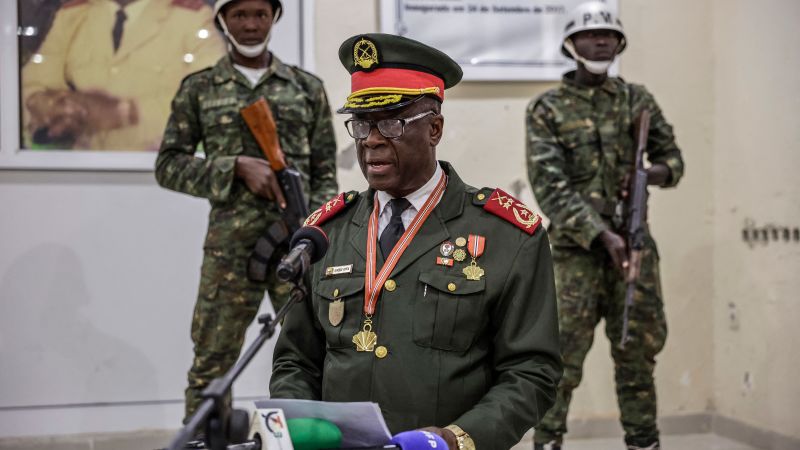
Guinea-Bissau’s military installed Major-General Horta Nta Na Man as transitional president after soldiers toppled President Umaro Sissoco Embalo following a disputed election; Embalo was flown to Senegal after regional intervention and the junta said the transition will last one year. Regional bodies (ECOWAS, the African Union and the EU) condemned the coup, election observers are unaccounted for, banks and businesses were closed in the capital, and the takeover heightens political risk in this cocaine-transit hub—raising contagion and investor-risk concerns for the fragile West African region.
Market structure: The coup in Guinea-Bissau is a localized political shock with outsized regional sentiment effects — expect immediate risk-off flows into USD, gold (GLD), and US Treasuries (TLT) and upward pressure on EM sovereign spreads (EMB) by ~20–80 bps in the next 1–4 weeks depending on escalation. Losers: frontier-market ETFs (iShares FM), West African banks and payment processors with FX/clearing links to Guinea-Bissau; winners: defense/security contractors and insurance/reinsurance names if conflict/route disruptions widen. Cross-asset: expect FX weakness vs USD for CFA-franc corridor, wider CDS/sov spreads, modest commodity bid for gold and shipping insurance rates if maritime drug routes re-route.
Risk assessment: Tail risks include ECOWAS military intervention, regional sanctions, or a prolonged junta (low-probability, high-impact) that could push regional EM spreads >100 bps and disrupt regional trade corridors within 2–6 months. Short-term (days–weeks): liquidity squeezes and halted banking operations in Bissau; medium-term (1–6 months): reputational/AML clampdowns on ports could raise transaction costs; long-term (>6 months): entrenched narcotrafficking influence worsening governance and sovereign-credit fundamentals. Hidden dependency: political funding from narcotraffickers implies sanctions/anti-money-laundering moves could have outsized spillovers into otherwise unrelated West African financial flows.
Trade implications: Tactical defensive posture — increase duration and safe-haven exposure: consider 2–4% tactical long TLT and 1–2% GLD for 1–3 month horizon; buy downside protection on EMB (1–2% notional) via 3-month puts or short ETF to capture spread widening. Relative-value: pair long U.S. Treasuries (TLT) / short EMB to exploit spread compression if crisis escalates; buy a 3-month VIX call spread (e.g., 25/40) sized 0.5–1% to hedge volatility spikes. Entry/exit: initiate on spread move >25 bps and trim when spreads retrace to within 10–15 bps of pre-crisis levels or after 30–60 days.
Contrarian angles: Markets may over-discount long-term EM growth; this remains a localized event — if ECOWAS secures a negotiated civilian transition within 30 days, frontier ETFs (FM) and selective West African bank stocks could rally 8–20% from panic lows. Historical parallels (Mali 2012) show a 3–6 month snapback after initial sell-off; set buy triggers on FM or country ETFs at >10% drawdown from intraday post-coup levels and maintain positions for 3–9 months. Unintended consequence: aggressive sanctions or interdiction could increase shipping/insurance costs and benefit maritime security contractors — watch IMO/insurer notices as early indicators.
AI-powered research, real-time alerts, and portfolio analytics for institutional investors.
Request DemoOverall Sentiment
strongly negative
Sentiment Score
-0.70
