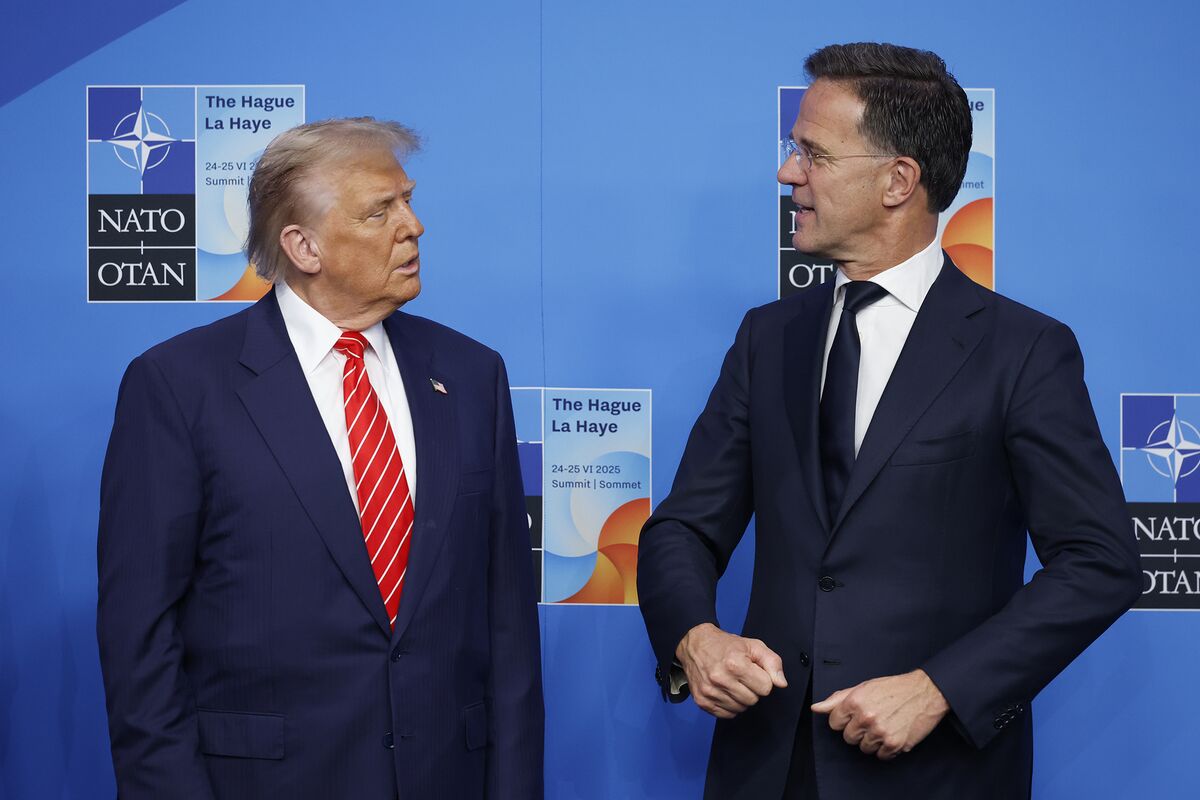
President Trump will raise the possibility of the U.S. leaving NATO when he meets the alliance’s secretary general, accusing NATO of failing during the Iran conflict. The comment raises geopolitical policy risk and could prompt a near-term risk-off reaction benefiting defense contractors and safe-haven assets; monitor Treasuries, USD and defense names. The outcome is highly uncertain and will depend on follow-up statements and alliance responses.
Political rhetoric that increases the perceived chance of a US-Europe security decoupling acts like a shock to risk premia, not fundamentals: expect a near-term volatility spike across FX, sovereign credit, and cyclical European assets for days-to-weeks, followed by a 3–12 month re-pricing of defense procurement assumptions. Market mechanisms: credit spreads on peripheral sovereigns and EURUSD typically move first (EURUSD can swing 1–3% intraday on headline risk), then defence contractors and industrial suppliers re-rate as investors re-run order-book scenarios over 12–36 month procurement cycles.
Second-order supply-chain effects matter more than headline headlines — any credible prospect of reduced NATO cohesion accelerates onshoring/reshoring of munitions, shipbuilding, and C4ISR manufacturing in continental Europe and the US. That benefits European primes and local component suppliers while creating transient capacity shortages in transatlantic subcontractors (fasteners, radars, semiconductors for defense), which can lift margins for commodity-exposed vendors for 6–18 months.
Tail risk is asymmetric and long-dated: true US withdrawal is low-probability in the next 12 months but would be high-impact across FX, rates and defense revenues over years; the more likely immediate outcome is episodic policy uncertainty and tactical increases in both US and European defense budgets. A reversal happens quickly if conciliatory signaling from allies or concrete bilateral guarantees restore confidence — watch diplomatic communiqués within 48–72 hours and US domestic budgeting language over the next 2–8 weeks as key catalysts.
AI-powered research, real-time alerts, and portfolio analytics for institutional investors.
Overall Sentiment
mildly negative
Sentiment Score
-0.35
