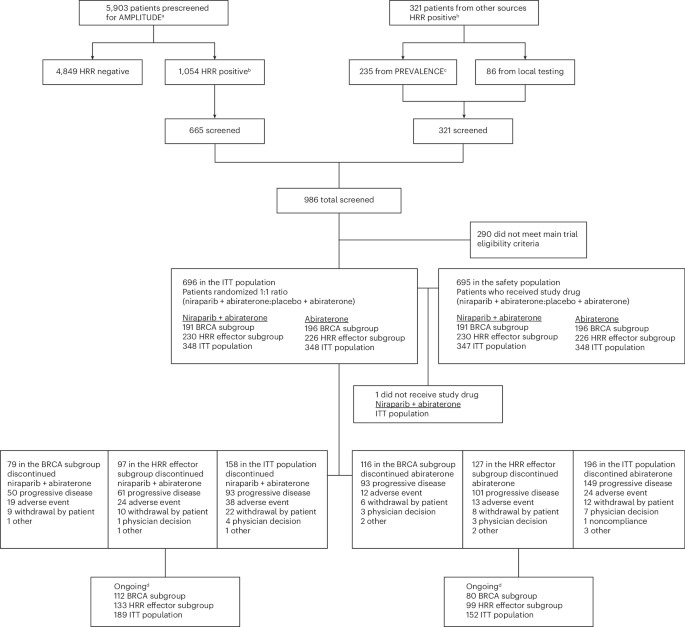
The Phase 3 AMPLITUDE trial, sponsored by Johnson & Johnson, demonstrated that combining niraparib, a PARP inhibitor, with abiraterone acetate and prednisone significantly improved radiographic progression-free survival (rPFS) in patients with metastatic castration-sensitive prostate cancer (mCSPC) harboring homologous recombination repair (HRR) gene alterations. The combination achieved a hazard ratio of 0.52 for rPFS in the BRCA subgroup (P < 0.0001) and 0.63 in the intention-to-treat population (P = 0.0001), indicating a clinically meaningful extension of progression-free life. While overall survival data remains immature, the regimen was associated with a higher incidence of Grade 3/4 adverse events (75% vs. 59%), primarily anemia and hypertension, and more treatment-emergent deaths, suggesting a trade-off between enhanced efficacy and increased toxicity for this patient population.
The Phase 3 AMPLITUDE trial, sponsored by Johnson & Johnson, demonstrated significant efficacy for the combination of niraparib, abiraterone acetate, and prednisone (AAP) in metastatic castration-sensitive prostate cancer (mCSPC) patients with HRR gene alterations. The primary endpoint of radiographic progression-free survival (rPFS) was met, showing a hazard ratio of 0.52 (P < 0.0001) in the BRCA subgroup and 0.63 (P = 0.0001) in the intention-to-treat population, indicating a substantial extension of progression-free survival. Significant improvements were also observed in time to symptomatic progression (HR=0.50) and time to subsequent therapy (HR=0.54), though overall survival (OS) data remains immature (HR=0.79).
The safety profile showed a higher incidence of Grade 3 or 4 adverse events (75% vs. 59%) in the niraparib combination arm, primarily anemia (29.1% vs. 4.6%) and hypertension (26.5% vs. 18.4%), with 25.1% of patients requiring blood transfusions. More treatment-emergent deaths occurred in the niraparib group (14 vs. 7), but adverse events were generally manageable with dose modifications, and long-term quality of life showed minimal detriment from cycle 5.
This trial marks the first demonstration of a PARP inhibitor's efficacy in mCSPC, positioning the niraparib combination as a potential new first-line treatment option for HRR-deficient patients. The robust rPFS data underscores clinical utility, emphasizing the increasing importance of routine HRR gene testing for patient selection and expanding the market for PARP inhibitors in earlier disease stages.
AI-powered research, real-time alerts, and portfolio analytics for institutional investors.
Request DemoOverall Sentiment
strongly positive
Sentiment Score
0.75
Ticker Sentiment
