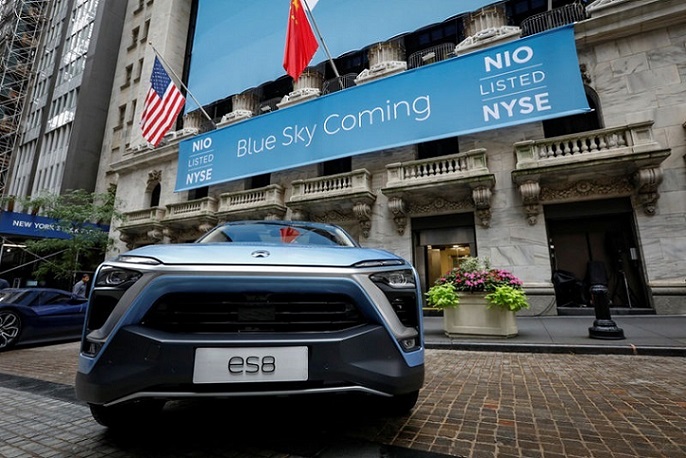
NIO swung to a Q4 profit of ¥282.7M vs a ¥7.11B loss year earlier, driving shares up as much as 19.7% to HK$45.66. Q4 revenue rose 75.9% YoY to ¥34.65B, vehicle sales climbed 80.9% to ¥31.61B and deliveries increased 71.7% YoY to 124,807 units; vehicle margin expanded to 18.1% from 13.1% and overall gross margin rose to 17.5%. Full-year revenue was ¥87.49B with total deliveries of 326,028 vehicles, and NIO guided Q1 2026 deliveries of 80,000–83,000 vehicles.
NIO's reported profitability and margin progress materially change the competitive map: the company now has optionality to compete on feature-rich higher-margin models rather than only on volume-driven incentives. That second-order effect increases bargaining leverage with battery and semiconductor suppliers (CATL, AESC/LGES equivalents), allowing NIO to lock in lower unit costs or preferential delivery windows — a meaningful supply-chain moat versus cash-constrained peers.
Near-term catalysts are guidance and delivery cadence; medium-term drivers are recurring revenue (software, charging/leasing) and autonomous stack monetization. Key reversal risks include a rapid return to price-led competition in China, battery-metal cost inflation, or a macro consumption shock that compresses ASPs; each could undo margin gains within 1–3 quarters rather than years.
From a market-structure perspective, the upside is partly technical — sentiment is cyclic and flows into Chinese EVs move rapidly around liquidity events — so short-term outperformance may attract momentum trading and volatility. The more durable investment case is execution on product roadmap and structural cost declines (battery chemistry mix, manufacturing efficiency), which play out over 6–24 months and are underpriced by traders focused on quarterly headlines.
Contrarian tail: the market may under-appreciate the durability of higher margins because investors assume Chinese EVs will re-enter a destructive price war; if NIO uses near-term free cash to accelerate software/subscription rollout and stabilize gross margin, upside could be multiperiod. Conversely, if peer pricing reactions force promotional activity, expect a fast multiple contraction; position sizing should reflect a binary payoff over the next 3–9 months.
AI-powered research, real-time alerts, and portfolio analytics for institutional investors.
Request DemoOverall Sentiment
strongly positive
Sentiment Score
0.75
Ticker Sentiment
